Craig Manson over at Geneablogie has started a new meme which I think is important since it gets the surnames in my genealogy research info out into the blogosphere. As Craig put it:
"List the surnames you are researching and the general localities. Then tell the names of your “Most Wanted Ancestors,” that is, the ones you most want to find behind that brickwall."
Note: I have been particular with the formatting of the information below and use ________ Surname hoping this will allow more people using Google and other search engines to find my post. Also I am using _______ County for the same reasons.
AUSTIN Surname: New York (Jefferson County, Lewis County, St. Lawrence County); Rhode Island (Kent County, Washington County)
CHRISTIANA Surname: New York (Dutchess County, Ulster County)
CRANDALL Surname: Rhode Island (Kent County, Washington County)
DEGROODT Surname: New York (Dutchess County, Ulster County)
DENCE Surname: New York (Lewis County)
FARREN Surname: New York (Bronx County, Kings County); Ireland (Belfast)
FINEHOUT Surname: New York (Dutchess County, Ulster County)
HENNEBERG Surname: New York (Bronx County, Kings County, Queens County, Nassau County), New Jersey (Essex County, Hudson County)
KROM Surname: New York (Dutchess County, Ulster County)
LEEHIVE Surname: New York (Ulster County)
MACENTEE Surname or MCENTEE Surname: New York (Dutchess County, Orange County, Ulster County)
MCGINNIS Surname or MCGINNES Surname: New York (Bronx County, Kings County), Ireland (County Monaghan
PRESSNER Surname: New York (Bronx County, Kings County, Queens County)
PUTMAN Surname: New York (Albany County, Montgomery County, Schenectady County)
SLATTERY Surname: New York (Orange County, Ulster County)
MOST WANTED ANCESTOR: Frances Pressner, my Great Grandmother, born abt 1889 in Liepsig, Germany, died March 10, 1960, Bronx County, New York. Having her parents info would allow me to know all 16 of my great-great grandparents.

Showing posts with label McGinnis. Show all posts
Showing posts with label McGinnis. Show all posts
Friday, February 27, 2009


Sunday, January 11, 2009
Who Are You? I Thought I Knew . . .

Unknown Boys, 1892. Digital photograph. Privately held by Thomas MacEntee, [ADDRESS FOR PRIVATE USE,] Chicago, Illinois. 2008.
This post was composed for the 9th Edition of Smile For The Camera ~ A Carnival of Images
. . . but now I am stumped. The photo above was one of many in The Box - a large plastic container filled with family items after cleaning out my mother's house in New York back in 2006. On the back is the date 1892 written in pencil on the top. The studio is The World Portrait Studio at 272 Bowery (Manhattan), New York.
The photo is one of many which are unlabeled and while others in a similar state have been solved in terms of identifying subjects and dates, this one remains confounding. I have my suspicions but I need to mention three other photos which I feel might be related to the one I am calling Unknown Boys.

Elizabeth McGinnis, abt. 1906. Digital photograph. Privately held by Thomas MacEntee, [ADDRESS FOR PRIVATE USE,] Chicago, Illinois. 2008.
Above is a great photo, although its mounting is in poor condition and is one of my top priority conservation projects. It is of Elizabeth Veronica McGinnis, my great grand aunt. She was born about 1889 and died January 23, 1956 in New York City. I love the "Gibson Girl" look and I am assuming that this may have been her high school graduation photo which would date it to around 1906 or 1907.

John McCrickert and Elizabeth McGinnis, abt. 1906-1908. Digital photograph. Privately held by Thomas MacEntee, [ADDRESS FOR PRIVATE USE,] Chicago, Illinois. 2008.
Next, above is another photo which is unidentified but I am positive that it too is of Elizabeth McGinnis with her soon-to-be husband John McCrickert. John was born August 11, 1887 and died December 11, 1955, both in New York City. While I do not have a marriage date, I am dating this photograph around the same time as the portrait of Elizabeth McGinnis or within two years, 1906 - 1908.

John, Maragaret and Edward McCrickert, abt. 1895. Digital photograph. Privately held by Thomas MacEntee, [ADDRESS FOR PRIVATE USE,] Chicago, Illinois. 2008.
One photo that is positively identified is the one above. It is of John, Margaret and Edward McCrickert and was taken at the Silkworth Studio in Brooklyn, New York. John was born in 1887, Edward in 1888 and Margaret about 1893, all in New York. Judging from the photo, I place Margaret's age at about two years, dating the photo around 1895. This makes John age eight and Edward age seven based on the estimated date.
So with these three identifiable photos, I thought that the two boys in the first photo might just be John and Edward McCrickert. But to my eye there is not much resemblance between these two unidentified boys and the ones with Margaret McCrickert. I did further research in my database and I thought it might be the brothers of my great-grandfather John Ralph Austin (1896 - 1976). The evidence does not support such a theory since John's oldest brother Maurice Ira Austin was not born until 1890 which would make him two years old in the photo. In addition, the Austin family lived in Lowville, New York near Watertown and would not arrive in New York City until around 1903.
I have no other possible listings in my genealogy database which might help identify these two boys. Another theory is that the photo is misdated in having 1892 written on the back. To my eye, they look older than John and Edward McCrickert in the photo dated 1895. If the unknown photo is mislabeled, it could very well be Maurice Ira and Harry Dence Austin.
So I will work on resolving the mystery of the unknown boys. While not having information placed on the photos frustrates me, I'd much rather have that than what has happened to many of the photos in The Box: in my great-grandmother Therese (McGinnis) Austin's later years, she insisted on circling the heads of photo subjects and writing their names in ink.
So with these three identifiable photos, I thought that the two boys in the first photo might just be John and Edward McCrickert. But to my eye there is not much resemblance between these two unidentified boys and the ones with Margaret McCrickert. I did further research in my database and I thought it might be the brothers of my great-grandfather John Ralph Austin (1896 - 1976). The evidence does not support such a theory since John's oldest brother Maurice Ira Austin was not born until 1890 which would make him two years old in the photo. In addition, the Austin family lived in Lowville, New York near Watertown and would not arrive in New York City until around 1903.
I have no other possible listings in my genealogy database which might help identify these two boys. Another theory is that the photo is misdated in having 1892 written on the back. To my eye, they look older than John and Edward McCrickert in the photo dated 1895. If the unknown photo is mislabeled, it could very well be Maurice Ira and Harry Dence Austin.
So I will work on resolving the mystery of the unknown boys. While not having information placed on the photos frustrates me, I'd much rather have that than what has happened to many of the photos in The Box: in my great-grandmother Therese (McGinnis) Austin's later years, she insisted on circling the heads of photo subjects and writing their names in ink.
Monday, November 10, 2008
Alzheimer’s Disease – A Duty and A Toll
This post was written for the 60th Edition of the Carnival of Genealogy hosted by Jasia at Creative Gene.
[Editor’s note: A little more than a year ago, on October 16, 2007, I posted about my family’s journey down a road all too familiar to many other families: the road called Alzheimer’s Disease. In that post, I discussed recent developments in a blood test that could predict the probability of developing Alzheimer’s Disease. I challenged readers with this question: would you take such a test, even if you had already traveled through what I call “the long goodbye” with a loved one? Would you want to know your chances of having to walk that same path? Below is that post in its entirety.]
I heard the news yesterday that a new blood test was being developed at Stanford University in California that could help detect the probability of developing Alzheimer's Disease within two to six years. While the results are still preliminary and the next step is to open up the testing to a larger test population, it has had a 91% accuracy so far.
Some of you know that my mother, Jacqueline Austin MacEntee, was diagnosed with dementia, one of the early indicators of Alzheimer's disease in 2000 at the age of 58. I can relate to you what I and my family had to endure just to get Mom diagnosed.
The diagnosis currently starts with a visit to a doctor for basic tests (blood, liver, cholesterol, heart, etc.) and then being sent to a specialist for neurological testing such as an MRI. Once everything is cleared as to possible causes, comes a visit to a gerontologist and a test consisting of about 30 questions. Questions are basic (the current day or year, the current president, etc.) and some are more complex (reading a small story and then relating what the story was about or who the main character was). This is usually when the diagnosis is positive as to Alzheimer's Disease.
And so it begins. You know it eventually has to end, and how it ends, but it just seems like it never ends.
You notice a marked change in behavior and instances where Mom just isn't herself. Many times you call and ask her what she did over the weekend or what movie she saw and she can't remember. Then it becomes the lack of remembering simple things like how to drive from point A to point B in a small town where Mom has lived for over 40 years. But you also rejoice when your mother utters her disgust about Bush and the other's in his administration who've hijacked our democracy. Part of you says "it's just the Alzheimer's" while part of you says it is clarity and another part of you hopes that all the years of discussing your own views have influenced her.
The disease progresses to affect employment and the means of earning a living and surviving financially. You deal with the chief at the village police office where she works as a dispatcher and clerk when he tells her that she has "psychological problems." She loses the second job at a local restaurant because she can no longer handle the bookkeeping responsibilities. You step in to get Mom out on early retirement via Social Security and still you need to fight, hire an attorney, and attend hearings, meetings, etc. But you feel good that you are able to get Mom out on retirement early so that she can enjoy the few good years she has left going to movies, shopping, etc.
And the denial, the denial, the denial -- from both Mom, me and the rest of the family -- that this is really happening. Much of the denial is the realization that by watching Mom and the deterioration of her condition, you could be looking in a mirror held up to your face so that you know your own mortality. Even worse, that you come to the realization that this could be you. "There but for the grace of God . ."
You drag your partner into the mess, the person you want to spend the rest of your life with, the person who may very well be doing all this for you one day. But you know that he'd gladly make the sacrifices just as you would for him or for his parents.
Then there are the financial scammers that come out of the woodwork. Her "financial advisor" at New York Life who talked her into an annuity that only made money for the advisor. And then the same advisor selling Mom expensive health books and vitamins as a treatment for the disease. I know - I cleaned out the house, saw the books, and have the receipts.
And as the months progress into years, the gerontologist's test is given at least yearly and the number of correct answers dwindles from 22 to 20 to 17.
You decide to take the car away after several instances of U-turns through the grassy median of a 4 lane highway. You notice unexplained dents and dings to the car or even to the house or garage. You have to fight and get a letter from the doctor to give to DMV in order to take the car away.
If you are smart or lucky or both, you find a good elder law attorney and you do this early when Mom can adequately communicate her wishes. Wishes such as "do not resuscitate", funeral and burial, will, assets, care, etc. The power of attorney kicks in and you have so much more responsibility than just making sure Mom is comfortable. But you know you and your family are lucky, and smart, because you did this early. You didn't wait to find out that investments were sucked dry by scammers who sell home improvements or driveway repaving or annuities. Boy were you lucky.
While you sort through the tangled financial web of the past five years, you try to arrange for in-home care for Mom, knowing that having the familiar around her is the best thing. You arrange for adult day care at the local hospital where on a given day she is probably the youngest one there but most definitely the most ambulatory. You bring in local women who specialize in elder care to stay with her the other 16 hours of the day and also to transport her to day care and doctors' appointments. You want to keep her in the home she bought 25 years ago, as a divorced parent with two boys and little credit. You know she deserves this and you and the rest of the family make sacrifices so this will happen.
You decide that while you've enjoyed living in California for the past 20 years, you can't handle all the tasks and responsibilities from so far away. The telephone, e-mail and the internet only work up to a point. You move to Chicago so you are at least a short two hour flight away, with three flights to New York each hour from O'Hare. You feel blessed because your employer in California believes in you and your work and the sacrifices you are making so much that they let you work from home in Chicago since they don't have an office there. You thank Heller Ehrman LLP and all your work family from California to London for being so supportive.
You get so caught up in the politics of family, and the squabbling and the pettiness that you decide to walk away altogether. You decide it isn't that you aren't up to the responsibility but that you don't know why family has to make it all so complicated - especially those who are selfish and want this to be about them and not about Mom. A simple Thanksgiving day phone call turns into a yelling match with your aunt who doesn't know how to handle Mom or why she has been accused of stealing a book or moving furniture. You decide you need a break so you don't call for close to six months and you drop out. And you feel guilty, as you should. And every time you are willing to put it behind you and focus on what Mom needs now because you are back in the mix, someone is there to remind you of how you walked away.
And besides bleeding tears, you bleed money. Your mother's money. The money she worked so hard for at the phone company before she went out on retirement due to a bad back. The money she earned working for the state at the police station. The SSI money. You run credit reports and find out there are over 100 credit cards in her name, many from stores like Macy's (where she had 6 accounts!) with clerks who say "would you like to save 15% today by opening a Macy's account?" knowing that Mom already had other Macy's accounts but the $5 commission was all that mattered. You close all the accounts, cash out IRAs and that damned annuity at a loss. You end up paying federal and state income tax as if Mom earned over $100,000 that year all because you had to cash in the investments for her care. But you also know that this is the best thing to do in this moment because it means months of in-home care, and safety and security. That's why we save for rainy days and right now it is pouring.
And the number of correct answers, at least on that test, becomes 15, then 12, then 10. For the rest of the process there are no correct answers, there are no touchstones because you've never been this way before. Oh how you don't want to be here right now but oh how you do because it's all about Mom.
Besides untangling finances, you have to untangle agreements and understandings that Mom entered into with other family members but had not the mental capacity nor the right to enter into. You deal with the house in Florida and you deal with Mom's home. You deal with the Grahamsville property that Mom inherited from her great-grandmother (Therese McGinnes Austin) for all her years of sacrifice and care. You realize that Mom entered into a purchase agreement with a family member who has since rented the property out but that person can't prove their payments to Mom or for taxes. You know that property meant so much to Mom as a kid but you also know the best thing is to let it go and realize that she was taken advantage of and to just deal with it. You deal, you deal, you deal. Until you think all the cards are dealt.
You fight with other family members who either think they know how to care for an Alzheimer's patient or want to keep denying that their sister has the disease. Because there's a small chance, given that the oldest sister already died from Alzheimer's, that they are next on the list to get it. But you also find other supportive family members who are glad to pitch in and actually make so many sacrifices for your mother when you know they already have their hands full.
Then comes the time to talk to Mom about finding a "facility" for her long-term care when either the finances or patience runs out, or both. You dread the discussion you have to have on Mother's Day, of all days, but you find she takes it well. Then you wonder if she really understands that a facility means a nursing home. You wonder if she is clear enough to figure it out over the next few weeks and retreat back into the denial stage. You have visions of that scene in the Exorcist when the priest puts his mother in an inner city nursing home yelling "Demi, why you do this to me? I'm afraid Demi." But you realize that when you see her a month later that she's lost over 20 lbs, she's eating better, she has lots of activities. She is safe, she is happy, she is living in the moment.
Next you have to clean out the house you grew up in and you don't know where to start. You make six trips in one year, buying boxes when you step off the plane to Newark. Working long hours sorting through every scrap of paper, every wadded up tissue in a sweater or pants pocket because it might contain something of value, every book some of which would have a gold bracelet as a bookmark. You remember that Mom took care of your great-grandmother and your great-aunt (Ethel McCrickert Hannan) in that same house and realize that their possessions are still there. You get angry when you find all the crap and junk she's been sold, be it greeting cards (why are there 100 of the same Thanksgiving card from a Hallmark store? I know I won't ever live to see 100 Thanksgivings), or the wrapping paper that people sell for their kid's school, or the needless health books, vitamins, and other quackery and the expensive overpriced dolls from China which are probably decorated with lead paint. And you hope that however crappy or tacky or useless, these things brought her joy and made her happy, even if for a moment.
You sort, you throw away. You become cold, efficient, without feeling as you decide not to pause and look at a photo album - you just toss it in The Box. You donate clothing to thrift stores, you sell antique items that no one wants and that you can't send home to Chicago. Your aunt has a great idea to donate most of the 100+ dolls to a shelter for battered women and children. And when you are back home, you enjoy The Box and all its photos, diaries, etc. later in the year - it is the beginning of this project and other genealogy projects. You feel lucky to have photos from your ancestors and to begin to know who you are.
You have lots of help from family members that you can never thank enough. You didn't do it alone although you feel lonely and have a deep sense of loss most of the time. You thank your Uncle Jerry for all the help from the beginning - for attending hearings, meetings, taking care of finances, arranging in-home care and the nursing home. All of this was not possible without him and without Nan's support. You thank your Uncle Lem and Aunt Judy for helping clean out the house. You thank your Aunt Joan for providing a year of room and board to Mom despite the aggravation and the problems. You thank Beth for making the trip from Delhi and visiting. You thank all your other relatives who make visits at the nursing home, visits Mom won't remember five minutes later, but visits that you know make her happy despite the visitor being saddened by what they see or wanting to cry. And you thank all her friends, even the ones who no longer keep in touch because it is just too uncomfortable.
You keep in touch with family and friends who call and want an update on Mom. Or you get updates from them when they go for a visit at the nursing home. While you notice the deterioration in her condition on each visit, you hear from relatives that she has an ankle brace due to a fall, or this problem or that problem. And still you know you've done the best thing for Mom.
The time you get to spend with Mom becomes shorter and shorter - not because you don't want to visit, but because her attention span doesn't enable her to focus on any one thing for more than 30 seconds. You call the nurses’ station to talk to her and after a short conversation, you realize she put the phone on the counter and walked away. Not because there was something more interesting, but because she can't focus.
And the list of correct answers to that test are now in the single digits. You know what the future holds and you dread it. You don't want to go through the first time Mom doesn't know who you are, but you know it will happen. You already see the difficulty she has in eating, getting on and off an elevator (she won't get on because she thinks you are getting off to visit her), or getting in and out of a car. You know what the next steps are because just like this article, you've read them in some blog or book or news article or website. You know Mom will suddenly stop talking, stop walking, stop eating, stop breathing.
But you will always know that you are your mother's son. And that she knew that too.
I've decided that I can either be bitter or I can be better. And bitter won't change my mother's condition - just mine. I choose better and the way I can do that is to:
a) talk about my mother's experience with people like writing this article;
b) mention the bad times as well as the good times, the negative as well as the positive but focus more on the positive - the negative is there as a reminder but not something to regret for it can't be changed;
c) not regret the journey of Alzheimer's for me, for Mom and for the others involved - for a journey has lessons;
d) understand that I did and do the most that is possible for my mother's care given the circumstances, finances and that I was lucky to have other family members involved; and
e) honor my mother and the way she raised me by not forgetting her sacrifices and her love, her challenges and her gifts, her mistakes and her accomplishments.
After all this, would I want to take a blood test, or any test, that would help predict whether or not I was to have Alzheimer's Disease? You're damned right I would. Not only would it help progress the research that has already been done, but it would help me prepare for the future. And I could live life and every day as if it were important and my last. I wouldn't make someone else go through that dark twisting tunnel of care unguided and with those feelings of helplessness. Knowledge is power and power, be it the power of health, finances or love, can help you conquer all adversities.
Would you take the test?
[Editor’s note: A little more than a year ago, on October 16, 2007, I posted about my family’s journey down a road all too familiar to many other families: the road called Alzheimer’s Disease. In that post, I discussed recent developments in a blood test that could predict the probability of developing Alzheimer’s Disease. I challenged readers with this question: would you take such a test, even if you had already traveled through what I call “the long goodbye” with a loved one? Would you want to know your chances of having to walk that same path? Below is that post in its entirety.]
I heard the news yesterday that a new blood test was being developed at Stanford University in California that could help detect the probability of developing Alzheimer's Disease within two to six years. While the results are still preliminary and the next step is to open up the testing to a larger test population, it has had a 91% accuracy so far.
Some of you know that my mother, Jacqueline Austin MacEntee, was diagnosed with dementia, one of the early indicators of Alzheimer's disease in 2000 at the age of 58. I can relate to you what I and my family had to endure just to get Mom diagnosed.
The diagnosis currently starts with a visit to a doctor for basic tests (blood, liver, cholesterol, heart, etc.) and then being sent to a specialist for neurological testing such as an MRI. Once everything is cleared as to possible causes, comes a visit to a gerontologist and a test consisting of about 30 questions. Questions are basic (the current day or year, the current president, etc.) and some are more complex (reading a small story and then relating what the story was about or who the main character was). This is usually when the diagnosis is positive as to Alzheimer's Disease.
And so it begins. You know it eventually has to end, and how it ends, but it just seems like it never ends.
You notice a marked change in behavior and instances where Mom just isn't herself. Many times you call and ask her what she did over the weekend or what movie she saw and she can't remember. Then it becomes the lack of remembering simple things like how to drive from point A to point B in a small town where Mom has lived for over 40 years. But you also rejoice when your mother utters her disgust about Bush and the other's in his administration who've hijacked our democracy. Part of you says "it's just the Alzheimer's" while part of you says it is clarity and another part of you hopes that all the years of discussing your own views have influenced her.
The disease progresses to affect employment and the means of earning a living and surviving financially. You deal with the chief at the village police office where she works as a dispatcher and clerk when he tells her that she has "psychological problems." She loses the second job at a local restaurant because she can no longer handle the bookkeeping responsibilities. You step in to get Mom out on early retirement via Social Security and still you need to fight, hire an attorney, and attend hearings, meetings, etc. But you feel good that you are able to get Mom out on retirement early so that she can enjoy the few good years she has left going to movies, shopping, etc.
And the denial, the denial, the denial -- from both Mom, me and the rest of the family -- that this is really happening. Much of the denial is the realization that by watching Mom and the deterioration of her condition, you could be looking in a mirror held up to your face so that you know your own mortality. Even worse, that you come to the realization that this could be you. "There but for the grace of God . ."
You drag your partner into the mess, the person you want to spend the rest of your life with, the person who may very well be doing all this for you one day. But you know that he'd gladly make the sacrifices just as you would for him or for his parents.
Then there are the financial scammers that come out of the woodwork. Her "financial advisor" at New York Life who talked her into an annuity that only made money for the advisor. And then the same advisor selling Mom expensive health books and vitamins as a treatment for the disease. I know - I cleaned out the house, saw the books, and have the receipts.
And as the months progress into years, the gerontologist's test is given at least yearly and the number of correct answers dwindles from 22 to 20 to 17.
You decide to take the car away after several instances of U-turns through the grassy median of a 4 lane highway. You notice unexplained dents and dings to the car or even to the house or garage. You have to fight and get a letter from the doctor to give to DMV in order to take the car away.
If you are smart or lucky or both, you find a good elder law attorney and you do this early when Mom can adequately communicate her wishes. Wishes such as "do not resuscitate", funeral and burial, will, assets, care, etc. The power of attorney kicks in and you have so much more responsibility than just making sure Mom is comfortable. But you know you and your family are lucky, and smart, because you did this early. You didn't wait to find out that investments were sucked dry by scammers who sell home improvements or driveway repaving or annuities. Boy were you lucky.
While you sort through the tangled financial web of the past five years, you try to arrange for in-home care for Mom, knowing that having the familiar around her is the best thing. You arrange for adult day care at the local hospital where on a given day she is probably the youngest one there but most definitely the most ambulatory. You bring in local women who specialize in elder care to stay with her the other 16 hours of the day and also to transport her to day care and doctors' appointments. You want to keep her in the home she bought 25 years ago, as a divorced parent with two boys and little credit. You know she deserves this and you and the rest of the family make sacrifices so this will happen.
You decide that while you've enjoyed living in California for the past 20 years, you can't handle all the tasks and responsibilities from so far away. The telephone, e-mail and the internet only work up to a point. You move to Chicago so you are at least a short two hour flight away, with three flights to New York each hour from O'Hare. You feel blessed because your employer in California believes in you and your work and the sacrifices you are making so much that they let you work from home in Chicago since they don't have an office there. You thank Heller Ehrman LLP and all your work family from California to London for being so supportive.
You get so caught up in the politics of family, and the squabbling and the pettiness that you decide to walk away altogether. You decide it isn't that you aren't up to the responsibility but that you don't know why family has to make it all so complicated - especially those who are selfish and want this to be about them and not about Mom. A simple Thanksgiving day phone call turns into a yelling match with your aunt who doesn't know how to handle Mom or why she has been accused of stealing a book or moving furniture. You decide you need a break so you don't call for close to six months and you drop out. And you feel guilty, as you should. And every time you are willing to put it behind you and focus on what Mom needs now because you are back in the mix, someone is there to remind you of how you walked away.
And besides bleeding tears, you bleed money. Your mother's money. The money she worked so hard for at the phone company before she went out on retirement due to a bad back. The money she earned working for the state at the police station. The SSI money. You run credit reports and find out there are over 100 credit cards in her name, many from stores like Macy's (where she had 6 accounts!) with clerks who say "would you like to save 15% today by opening a Macy's account?" knowing that Mom already had other Macy's accounts but the $5 commission was all that mattered. You close all the accounts, cash out IRAs and that damned annuity at a loss. You end up paying federal and state income tax as if Mom earned over $100,000 that year all because you had to cash in the investments for her care. But you also know that this is the best thing to do in this moment because it means months of in-home care, and safety and security. That's why we save for rainy days and right now it is pouring.
And the number of correct answers, at least on that test, becomes 15, then 12, then 10. For the rest of the process there are no correct answers, there are no touchstones because you've never been this way before. Oh how you don't want to be here right now but oh how you do because it's all about Mom.
Besides untangling finances, you have to untangle agreements and understandings that Mom entered into with other family members but had not the mental capacity nor the right to enter into. You deal with the house in Florida and you deal with Mom's home. You deal with the Grahamsville property that Mom inherited from her great-grandmother (Therese McGinnes Austin) for all her years of sacrifice and care. You realize that Mom entered into a purchase agreement with a family member who has since rented the property out but that person can't prove their payments to Mom or for taxes. You know that property meant so much to Mom as a kid but you also know the best thing is to let it go and realize that she was taken advantage of and to just deal with it. You deal, you deal, you deal. Until you think all the cards are dealt.
You fight with other family members who either think they know how to care for an Alzheimer's patient or want to keep denying that their sister has the disease. Because there's a small chance, given that the oldest sister already died from Alzheimer's, that they are next on the list to get it. But you also find other supportive family members who are glad to pitch in and actually make so many sacrifices for your mother when you know they already have their hands full.
Then comes the time to talk to Mom about finding a "facility" for her long-term care when either the finances or patience runs out, or both. You dread the discussion you have to have on Mother's Day, of all days, but you find she takes it well. Then you wonder if she really understands that a facility means a nursing home. You wonder if she is clear enough to figure it out over the next few weeks and retreat back into the denial stage. You have visions of that scene in the Exorcist when the priest puts his mother in an inner city nursing home yelling "Demi, why you do this to me? I'm afraid Demi." But you realize that when you see her a month later that she's lost over 20 lbs, she's eating better, she has lots of activities. She is safe, she is happy, she is living in the moment.
Next you have to clean out the house you grew up in and you don't know where to start. You make six trips in one year, buying boxes when you step off the plane to Newark. Working long hours sorting through every scrap of paper, every wadded up tissue in a sweater or pants pocket because it might contain something of value, every book some of which would have a gold bracelet as a bookmark. You remember that Mom took care of your great-grandmother and your great-aunt (Ethel McCrickert Hannan) in that same house and realize that their possessions are still there. You get angry when you find all the crap and junk she's been sold, be it greeting cards (why are there 100 of the same Thanksgiving card from a Hallmark store? I know I won't ever live to see 100 Thanksgivings), or the wrapping paper that people sell for their kid's school, or the needless health books, vitamins, and other quackery and the expensive overpriced dolls from China which are probably decorated with lead paint. And you hope that however crappy or tacky or useless, these things brought her joy and made her happy, even if for a moment.
You sort, you throw away. You become cold, efficient, without feeling as you decide not to pause and look at a photo album - you just toss it in The Box. You donate clothing to thrift stores, you sell antique items that no one wants and that you can't send home to Chicago. Your aunt has a great idea to donate most of the 100+ dolls to a shelter for battered women and children. And when you are back home, you enjoy The Box and all its photos, diaries, etc. later in the year - it is the beginning of this project and other genealogy projects. You feel lucky to have photos from your ancestors and to begin to know who you are.
You have lots of help from family members that you can never thank enough. You didn't do it alone although you feel lonely and have a deep sense of loss most of the time. You thank your Uncle Jerry for all the help from the beginning - for attending hearings, meetings, taking care of finances, arranging in-home care and the nursing home. All of this was not possible without him and without Nan's support. You thank your Uncle Lem and Aunt Judy for helping clean out the house. You thank your Aunt Joan for providing a year of room and board to Mom despite the aggravation and the problems. You thank Beth for making the trip from Delhi and visiting. You thank all your other relatives who make visits at the nursing home, visits Mom won't remember five minutes later, but visits that you know make her happy despite the visitor being saddened by what they see or wanting to cry. And you thank all her friends, even the ones who no longer keep in touch because it is just too uncomfortable.
You keep in touch with family and friends who call and want an update on Mom. Or you get updates from them when they go for a visit at the nursing home. While you notice the deterioration in her condition on each visit, you hear from relatives that she has an ankle brace due to a fall, or this problem or that problem. And still you know you've done the best thing for Mom.
The time you get to spend with Mom becomes shorter and shorter - not because you don't want to visit, but because her attention span doesn't enable her to focus on any one thing for more than 30 seconds. You call the nurses’ station to talk to her and after a short conversation, you realize she put the phone on the counter and walked away. Not because there was something more interesting, but because she can't focus.
And the list of correct answers to that test are now in the single digits. You know what the future holds and you dread it. You don't want to go through the first time Mom doesn't know who you are, but you know it will happen. You already see the difficulty she has in eating, getting on and off an elevator (she won't get on because she thinks you are getting off to visit her), or getting in and out of a car. You know what the next steps are because just like this article, you've read them in some blog or book or news article or website. You know Mom will suddenly stop talking, stop walking, stop eating, stop breathing.
But you will always know that you are your mother's son. And that she knew that too.
I've decided that I can either be bitter or I can be better. And bitter won't change my mother's condition - just mine. I choose better and the way I can do that is to:
a) talk about my mother's experience with people like writing this article;
b) mention the bad times as well as the good times, the negative as well as the positive but focus more on the positive - the negative is there as a reminder but not something to regret for it can't be changed;
c) not regret the journey of Alzheimer's for me, for Mom and for the others involved - for a journey has lessons;
d) understand that I did and do the most that is possible for my mother's care given the circumstances, finances and that I was lucky to have other family members involved; and
e) honor my mother and the way she raised me by not forgetting her sacrifices and her love, her challenges and her gifts, her mistakes and her accomplishments.
After all this, would I want to take a blood test, or any test, that would help predict whether or not I was to have Alzheimer's Disease? You're damned right I would. Not only would it help progress the research that has already been done, but it would help me prepare for the future. And I could live life and every day as if it were important and my last. I wouldn't make someone else go through that dark twisting tunnel of care unguided and with those feelings of helplessness. Knowledge is power and power, be it the power of health, finances or love, can help you conquer all adversities.
Would you take the test?
Sunday, November 9, 2008
The Baby Picture That Started It All
This post was composed for the 7th Edition of Smile For The Camera ~ A Carnival of Images

John Ralph Austin, age 18 months. Lowville, New York, 1898. Digital image. Privately held by Thomas MacEntee, [ADDRESS FOR PRIVATE USE,] Chicago, Illinois. 2008.
My great-grandparents, John Ralph Austin and Therese Rose McGinnis were the first people to get me interested in genealogy and the history of my family. Growing up, I would hear stories of who my Dutch ancestors had arrived in New York during the 1660s.
But while the stories were always interesting, and always seemed to be embellished with each telling, it was the albums of photographs which captivated me the most. The photo above is of my great-grandfather and was taken at a professional studio in Lowville, New York where he was born.
I never saw this photo while my great-grandfather was alive but only after he had died in 1976. My great-grandmother gave this and others to me since she probably felt that I would be the one most likely to preserve the memories and keep telling the stories as they had.
John Ralph Austin was born on January 31, 1896 in Lowville and would be the last of the five sons of William Dence Austin to die, on April 20, 1976. Being the second youngest, I imagine that his outfit - which many today might call a "gown" - was passed down from his oldest brother Maurice Ira Austin who was born in 1890. With his blond hair, posed on an elaborate Victorian style over-sized chair, little did he know that 100 years later he would leave behind over 200 descendants across five subsequent generations.

John Ralph Austin, age 18 months. Lowville, New York, 1898. Digital image. Privately held by Thomas MacEntee, [ADDRESS FOR PRIVATE USE,] Chicago, Illinois. 2008.
My great-grandparents, John Ralph Austin and Therese Rose McGinnis were the first people to get me interested in genealogy and the history of my family. Growing up, I would hear stories of who my Dutch ancestors had arrived in New York during the 1660s.
But while the stories were always interesting, and always seemed to be embellished with each telling, it was the albums of photographs which captivated me the most. The photo above is of my great-grandfather and was taken at a professional studio in Lowville, New York where he was born.
I never saw this photo while my great-grandfather was alive but only after he had died in 1976. My great-grandmother gave this and others to me since she probably felt that I would be the one most likely to preserve the memories and keep telling the stories as they had.
John Ralph Austin was born on January 31, 1896 in Lowville and would be the last of the five sons of William Dence Austin to die, on April 20, 1976. Being the second youngest, I imagine that his outfit - which many today might call a "gown" - was passed down from his oldest brother Maurice Ira Austin who was born in 1890. With his blond hair, posed on an elaborate Victorian style over-sized chair, little did he know that 100 years later he would leave behind over 200 descendants across five subsequent generations.
Wednesday, October 15, 2008
A Safety Net Constructed of Blood
This post was written as part of Blog Action Day 2008
As a family-historian and genealogist, part of bringing to life the statistics of a family's existence is to learn how those people lived, worked, and survived. Like many of my fellow colleagues who blog about their genealogy research, I've not only encountered poverty within the confines of my ancestors' histories, but within my own history as well.
I grew up in upstate New York during the 1960s and 1970s, being raised mostly by my mother Jacqueline MacEntee. Raising two young boys solo was hard enough, but add to it a judicial system which refused to enforce child support payment laws, the prejudice against women in the working world and the economic downturn of the early 1970s - well, you could easily see yourself at the precipice of poverty.
Mom grew up in much worse circumstances, having been born in Jersey City, New Jersey and growing up in one of the first housing projects in the country. My mother was one of 12 siblings and to this day I just don't know how my grandparents managed with all those children to clothe and feed.
Like many families, they were part of a safety net constructed of blood - relatives helping relatives get through another day, another month, another year. My great-grandparents were a great help in that each summer they took in all 12 children and treated them to fresh air, home-grown food, and country fun.
Those same people did the same for my mother. My great-grandmother, Therese McGinnis Austin was always there for me, Mom and my brother and I don't just mean around holidays or for special occasions such as graduations and birthdays. Both she and her husband, John Ralph Austin, took an active interest in my survival, as it were, and made sure that Mom had what she needed to raise two young boys. I don't mean the monetary aspects - I mean the emotional, social and moral support that every child needs when growing up.
In reading back through the history of my family, it has always been this family-based system of "carrying each other through" that has enabled one generation to look at the next and say, "they do have it better than we did."
And in those same readings, I see many families who prospered during the 1920s and forgot the frugal ways under which they had lived or were raised, only to revert back to them during the Great Depression. I see the same thing happening in more recent times: people ditching their SUVs, eating out less, more brown bag lunches, stay-cations, etc. There are, however, some of us who never lost our frugal ways, and still hang on to some of them, to the obvious embarrassment and irritation of our children or our nieces and nephews.
So with a family history steeped in a tradition of “pulling oneself up by one’s bootstraps” or relying on family members for support, I am conflicted when I hear people speak of economic assistance with disdain. As if “those people” were being lazy, were not working hard enough, or didn’t deserve assistance.
In the past of my family, there has always been community assistance besides the family safety net – be it through local houses of worship or benevolent associations, etc. It’s just that we never took advantage of that. Some members of my family were the typical obstinate “I don’t accept charity” types while others saw a certain value in “doing for oneself.”
While all that is admirable, there should be no sense of failure in asking for help. There should be no shame in asking for help. In my mind, although my view is somewhat idealistic, any program whether it be faith-based or government run is not intended as a lifestyle, but as a “jump start” to being self-sufficient. Too many times I’ve overheard the not-so-silent “tsk tsk” when someone uses food stamps or a WIC card; I’ve seen people yell at those standing in line at a soup kitchen saying, “Get a job, ya bums!;” and I’ve actually witnessed one successful woman ask another how much her monthly Section 8 voucher was worth and why she had it.
We only choose to see what we want to see very often. It isn’t my role to judge, nor is it any of my business that the woman with the WIC payments was just abandoned by her husband; that a “bum” in the soup line is actually a skilled office worker who was laid off and then beset with health problems; that the woman with a voucher is actually taking care of her nieces and nephews while her sister deals with her drug habit.
Yes, there are people that abuse systems – any system – when it is set up for good. There will always be someone who will try to make bad out of good, to leverage something to their advantage. Perhaps, again, the idealist in me is holding the bar too high for my expectations of those in poverty.
But what is far worse to me is to be well-situated from an economic standpoint, yet be impoverished of mind, and starving of understanding.
And far worse is to not even know it.
As a family-historian and genealogist, part of bringing to life the statistics of a family's existence is to learn how those people lived, worked, and survived. Like many of my fellow colleagues who blog about their genealogy research, I've not only encountered poverty within the confines of my ancestors' histories, but within my own history as well.
I grew up in upstate New York during the 1960s and 1970s, being raised mostly by my mother Jacqueline MacEntee. Raising two young boys solo was hard enough, but add to it a judicial system which refused to enforce child support payment laws, the prejudice against women in the working world and the economic downturn of the early 1970s - well, you could easily see yourself at the precipice of poverty.
Mom grew up in much worse circumstances, having been born in Jersey City, New Jersey and growing up in one of the first housing projects in the country. My mother was one of 12 siblings and to this day I just don't know how my grandparents managed with all those children to clothe and feed.
Like many families, they were part of a safety net constructed of blood - relatives helping relatives get through another day, another month, another year. My great-grandparents were a great help in that each summer they took in all 12 children and treated them to fresh air, home-grown food, and country fun.
Those same people did the same for my mother. My great-grandmother, Therese McGinnis Austin was always there for me, Mom and my brother and I don't just mean around holidays or for special occasions such as graduations and birthdays. Both she and her husband, John Ralph Austin, took an active interest in my survival, as it were, and made sure that Mom had what she needed to raise two young boys. I don't mean the monetary aspects - I mean the emotional, social and moral support that every child needs when growing up.
In reading back through the history of my family, it has always been this family-based system of "carrying each other through" that has enabled one generation to look at the next and say, "they do have it better than we did."
And in those same readings, I see many families who prospered during the 1920s and forgot the frugal ways under which they had lived or were raised, only to revert back to them during the Great Depression. I see the same thing happening in more recent times: people ditching their SUVs, eating out less, more brown bag lunches, stay-cations, etc. There are, however, some of us who never lost our frugal ways, and still hang on to some of them, to the obvious embarrassment and irritation of our children or our nieces and nephews.
So with a family history steeped in a tradition of “pulling oneself up by one’s bootstraps” or relying on family members for support, I am conflicted when I hear people speak of economic assistance with disdain. As if “those people” were being lazy, were not working hard enough, or didn’t deserve assistance.
In the past of my family, there has always been community assistance besides the family safety net – be it through local houses of worship or benevolent associations, etc. It’s just that we never took advantage of that. Some members of my family were the typical obstinate “I don’t accept charity” types while others saw a certain value in “doing for oneself.”
While all that is admirable, there should be no sense of failure in asking for help. There should be no shame in asking for help. In my mind, although my view is somewhat idealistic, any program whether it be faith-based or government run is not intended as a lifestyle, but as a “jump start” to being self-sufficient. Too many times I’ve overheard the not-so-silent “tsk tsk” when someone uses food stamps or a WIC card; I’ve seen people yell at those standing in line at a soup kitchen saying, “Get a job, ya bums!;” and I’ve actually witnessed one successful woman ask another how much her monthly Section 8 voucher was worth and why she had it.
We only choose to see what we want to see very often. It isn’t my role to judge, nor is it any of my business that the woman with the WIC payments was just abandoned by her husband; that a “bum” in the soup line is actually a skilled office worker who was laid off and then beset with health problems; that the woman with a voucher is actually taking care of her nieces and nephews while her sister deals with her drug habit.
Yes, there are people that abuse systems – any system – when it is set up for good. There will always be someone who will try to make bad out of good, to leverage something to their advantage. Perhaps, again, the idealist in me is holding the bar too high for my expectations of those in poverty.
But what is far worse to me is to be well-situated from an economic standpoint, yet be impoverished of mind, and starving of understanding.
And far worse is to not even know it.
Wednesday, September 24, 2008
Wordless Wednesday

Loretta McGinnis (1897 - 1971), Confirmation, abt. 1909. Digital image. Privately held by Thomas MacEntee, [ADDRESS FOR PRIVATE USE,] Chicago, Illinois. 2008.
Saturday, September 13, 2008
What Would I Take In A Disaster?
Julie Cahill Tarr over at GenBlog has posed an interesting topic which makes for a good blogging or journaling prompt:
1. The Sullivan-O'Keefe Wedding Silver
4. My Painting
5. The Family Jewels
Because my mom lives in constant fear of forest fires, she has an evacuation plan in place. Instead of fretting over what to take during a stressful evacuation, she grabs the list and starts packing. Even though I don't live in constant threat of forest fires, there are several other disasters that could occur.And with Hurricane Gustav gone, Ike here and who knows which tropical visitor will appear next, this is a good time for me to think about a) what possessions are most meaningful to me, b) where those items are right now, and c) which would I take with me in the event of an emergency.
I'm willing to bet that all of us family historians have files upon files of research used to construct our trees. I'm sure there are some of us who have some sort of "plan" to back up data on our computers or store hard-copies in fire-proof safes or in another location (if you don't, I suggest you have a plan in place). While some of these items could be replaced, such a death certificates, census data, etc.) there are some things that absolutely cannot be replaced. I'm talking about family heirlooms.
Many of us are so concerned with all of the records we've accumulated because of the blood, sweat, and tears that went into finding them, they we may overlook these precious heirlooms. So, following in the footsteps of my mom, I'm going to think long and hard and develop my own disaster plan.
I'm also interested to see what family heirloom(s) you would risk saving in the event of a disaster. Write a post on your blog explaining what you would save and why (include a picture if you like). If you'd like to participate, please send me an email with the link to your post by September 13.
1. The Sullivan-O'Keefe Wedding Silver
This is a very simple, handmade sterling silver set that I described here for the 55th Edition of the Carnival of Genealogy. Consisting of twelve forks with very long tines, twelve knives and three serving spoons hand-engraved with the name "O'Keefe," I know that the set was treasured by my 3 times great-grandmother Catherine Sullivan O'Keefe. I know where the set is but I really want to get a better storage mechanism for it - either a tarnish proof bag or a small chest.
2. My Great-Grandmother's Floradora Doll
I wrote about this doll which belonged to my great-grandmother Therese McGinnis Austin as she grew up at the turn of the 20th century. In A Man With Dolls, I described the doll which came from Germany and is in desparate need of repair. I really need to restore this doll to its former glory by taking it over to the doll hospital in Lincoln Park here in Chicago. Then I can hold on to it for a few more years before I give it to my niece Rosie in Virginia Beach who I know will cherish it as have many of the women in my family.
2. My Great-Grandmother's Floradora Doll
I wrote about this doll which belonged to my great-grandmother Therese McGinnis Austin as she grew up at the turn of the 20th century. In A Man With Dolls, I described the doll which came from Germany and is in desparate need of repair. I really need to restore this doll to its former glory by taking it over to the doll hospital in Lincoln Park here in Chicago. Then I can hold on to it for a few more years before I give it to my niece Rosie in Virginia Beach who I know will cherish it as have many of the women in my family.
3. The External Hard Drive
The keys to the kingdom as far as I'm concerned. If I ever needed to startup my computer-based ventures (blogging, employment, etc.) after a disaster, I will need my data which is faithfully backed up each month. The drive is small (7 inches x 5 inches) and can be grabbed in seconds and placed in a box or carried by hand. All my genealogy research and scanned photos are here as well.
4. My Painting
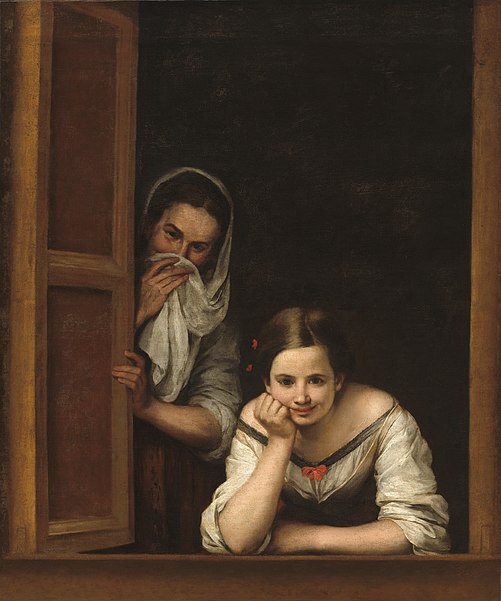
I will probably go more into depth on this item in a future Cabinet of Curiosities carnival, but this 8" x 12" painting was executed by me during my art studies in college. A copy of "Girl and Her Duena" by Murillo, you can barely see the numbers underneath the paint (lol) but I did make it from scratch (meaning I primed the Belgian linen, stretched it, ground my own pigments, etc.) and it means quite a bit to me.
5. The Family Jewels
No, not those - I never have to worry as to where they are. I have two items that mean more from a sentimental value perspective than their financial value.
My diamond stud earrings that I wear in each ear mean quite a bit to me. After I survived the 1989 Loma Prieta earthquake in San Francisco (squeezing under my desk on the 38th floor of Embarcadero Center), I decided to mark such an event by getting my ears pierced. And shortly after my 40th birthday I treated myself to a pair of 1/4 carat D color, IF clarity, Asscher cut diamonds. They are unique and the cut/style is not one you see everyday. Each time I see them I think back to how I survived that day in October, 1989.
The rings I had made from several items of family jewelry including old wedding bands and diamonds. I designed these and worked with a jeweler back in San Francisco. Each time I wear them, I am taking many generations in my hand and they travel with me on every journey.
Wednesday, August 13, 2008
Wordless Wednesday

Loretta and Alice McGinnis. Photograph dated abt. 1965. Digital image. Privately held by Thomas MacEntee, [ADDRESS FOR PRIVATE USE,] Chicago, Illinois. 2008.
Wednesday, August 6, 2008
Wordless Wednesday

Wedding Luncheon of Mr. & Mrs. McGinnis (with my great-grandparents John Ralph Austin and Therese McGinnis Austin in the foreground). Photograph dated Octobre 5, 1935. Digital image. Privately held by Thomas MacEntee, [ADDRESS FOR PRIVATE USE,] Chicago, Illinois. 2008.
Tuesday, July 22, 2008
If These Walls Could Talk
In yesterday's post entitled This Old House, I guess I prompted myself for further information about the various remodeling projects in my family. So here goes:
Growing up, did your family embark upon a major home improvement such as a kitchen, bathroom or building an addition for more space?
I remember growing up that we lived in an apartment until I was 15 when Mom bought her first house. Over the years, my mother practically performed a total rehab amounting to a "gutting" of the house. She put down tile, carpeting, resurfaced cabinets and drawers, installed ceiling fans, built a wall unit in the bedroom I shared with my brother, and more.
In addition, she replaced the old "shed" which covered the well and the bomb shelter (the house was built in 1949 after all) with a much larger shed which could have doubled as a garage. And she planted flowers, removed two huge willows trees that had tapped into the water supply.
Currently, I have rented the house to a great family that insists on making improvements and they do a great job. My next project is a bathroom replacement - the original bathtub from 1949 is still there!
Did anyone in your family history experience major damage to their home that required repair? What were the circumstances of the damage?
As I discussed in a recent post, the house that my great-grandparents retired to in Grahamsville, New York basically burned down in 1978. An investigation proved that it was arson and it was probably done to cover up a robbery of items. Grandma was living with us at the time, having returned from Florida for the winter. This was such a tragic loss for our family, especially since so many items of family history were lost.
One item which was thankfully recovered and refinished is Grandma's old wooden rocker. It probably is at least 100 years old now and in possession of my uncle. But items lost include a huge cedar chest which supposedly came over with a family member from Ireland. Photographs, a hat pin collection, paper ephemera, and more.
The house was never rebuilt.
Have you come across any family history related to when indoor plumbing was installed? An electric or gas stove instead of a wood stove? An ice box and then a refrigerator?
I remember Grandma's stories of the Grahamsville house as well as my mother's recollections. When they bought the house in the mid-1940s, there was no indoor plumbing, or if there was, it did not include toilets. My mother's greatest fear of using the outhouse (which was a two seater thanks to 12 grandchildren all summer long) was that a snake would be down below in that hole.
Grandma didn't have electricity until the late 1940s or early 1950s. Everything was done by kerosene lamp and cooking was done on a wood stove. Of course, growing up in the 1970s, she still had the original appliances from the early 1950s in the kitchen. And the old wooden ice box was down in the basement.
I believe telephones came to the backwoods of Grahamsville in the late 1950s and even then it was an 8-party line. I just can't image having to decipher the ring code to see if the call was for you. And I do remember, the 8-party line was there until the early 1970s. One time I overhead Grandma get into an argument with a woman who tended to sit and talk on the phone all day. I believe the words "selfish" and "common decency" were used.
Growing up, did your family embark upon a major home improvement such as a kitchen, bathroom or building an addition for more space?
I remember growing up that we lived in an apartment until I was 15 when Mom bought her first house. Over the years, my mother practically performed a total rehab amounting to a "gutting" of the house. She put down tile, carpeting, resurfaced cabinets and drawers, installed ceiling fans, built a wall unit in the bedroom I shared with my brother, and more.
In addition, she replaced the old "shed" which covered the well and the bomb shelter (the house was built in 1949 after all) with a much larger shed which could have doubled as a garage. And she planted flowers, removed two huge willows trees that had tapped into the water supply.
Currently, I have rented the house to a great family that insists on making improvements and they do a great job. My next project is a bathroom replacement - the original bathtub from 1949 is still there!
Did anyone in your family history experience major damage to their home that required repair? What were the circumstances of the damage?
As I discussed in a recent post, the house that my great-grandparents retired to in Grahamsville, New York basically burned down in 1978. An investigation proved that it was arson and it was probably done to cover up a robbery of items. Grandma was living with us at the time, having returned from Florida for the winter. This was such a tragic loss for our family, especially since so many items of family history were lost.
One item which was thankfully recovered and refinished is Grandma's old wooden rocker. It probably is at least 100 years old now and in possession of my uncle. But items lost include a huge cedar chest which supposedly came over with a family member from Ireland. Photographs, a hat pin collection, paper ephemera, and more.
The house was never rebuilt.
Have you come across any family history related to when indoor plumbing was installed? An electric or gas stove instead of a wood stove? An ice box and then a refrigerator?
I remember Grandma's stories of the Grahamsville house as well as my mother's recollections. When they bought the house in the mid-1940s, there was no indoor plumbing, or if there was, it did not include toilets. My mother's greatest fear of using the outhouse (which was a two seater thanks to 12 grandchildren all summer long) was that a snake would be down below in that hole.
Grandma didn't have electricity until the late 1940s or early 1950s. Everything was done by kerosene lamp and cooking was done on a wood stove. Of course, growing up in the 1970s, she still had the original appliances from the early 1950s in the kitchen. And the old wooden ice box was down in the basement.
I believe telephones came to the backwoods of Grahamsville in the late 1950s and even then it was an 8-party line. I just can't image having to decipher the ring code to see if the call was for you. And I do remember, the 8-party line was there until the early 1970s. One time I overhead Grandma get into an argument with a woman who tended to sit and talk on the phone all day. I believe the words "selfish" and "common decency" were used.
Tuesday, July 15, 2008
Well-Aged But Not Ripe

Therese McGinnis Austin (1894 - 1988). Photograph. June 1988, Rehoboth Beach, Delaware. Digital image. Privately held by Thomas MacEntee, [ADDRESS FOR PRIVATE USE,] Chicago, Illinois. 2008.
[This post was written for the 52nd Edition of the Carnival of Genealogy hosted by Lisa at 100 Years In America]
"It's not the years, honey, it's the mileage." Indiana Jones
I use the above line whenever I am asked my age. I find as I get older, I get asked less and less often. I do get a thrill when the door person at a local bar asks for my ID. In my usual, self-depricating manner, I ask them if they really want to see it and then say "I'm so old, my ID is printed on papyrus."
The concept of age brings up many issues for me, not just because I am hitting Middle Age, but because the way our society sees aging has changed greatly in the past 30 years.
Age In My Family Tree
Longevity tends to run along many of my family lines, more among the females which is not unexpected. My great-grandmother Therese McGinnis Austin with whom I was very close, died at the age of 94. As a child up through my teens, I was always fascinated with Grandma's stories of life in turn of the century New York City. While I could have easily learned about these things through any history book, it was special to hear about how life was lived back then by someone who actually lived it.
I am sure that some of the stories Grandma told were in fact either stories or were "amplified" but I think that is the prerogative of someone who has lived past 90 and lived a full life at that.
As a child, what was your reaction when you first encountered an elderly relative? Was it difficult to imagine that they had ever been your age, that they had ever been a small child? I know for me it was very difficult - even after being provided photographs, toys or clothes from a relative's childhood. I thought for sure that they were just trying to fool me.
Did Grandma have the same "issues" that I did growing up? I think while the issues may not be exact, many of them were quite similar. Just as I've adapted to the desktop computer, blogging, fax machines, ATMs, etc. - Grandma in her time had to deal with the radio, the phonograph, the car, etc. I don't know that the technology of the time matters - we both lived through the advent of new technologies that would have astounded our ancestors.
But some area of life were definitely different between our lives: women's rights and the right to vote; racial equality; improvements in health care and longevity. Many of these things I just take for granted but for Grandma they brought changes in life whether one was ready or not.
Age As Perception
Age is a matter of perception - of how we as an observer see age and the changes it brings to loved ones as well as how it impacts our perceptions of ourselves over time. But also society sees aging very differently from generation to generation.
In my family tree, during the 17th and 18th century, it was common for my ancestors to live to the ripe old age of 40 or 50. Forget that 60, 70 or 80 was uncommon with 90 being unheard of. With the Industrial Revolution, improvements to health care, the advent of indoor plumbing, electric, etc. more and more of my ancestors lived to be 50 or 60. And by the 20th century, 70 and 80 were just as common.
Even in my time, how old is "old" has changed. Remember the phrase "never trust anyone over 30?" Back in the 1960s, if you were in your 40s it was expected that you would have wrinkles, age lines, grey hair, etc. Back then my great-grandparents were already in their 70s and probably seemed ancient to anyone under 30.
Now, becoming a member of AARP happens at age 50 - and not many are ashamed of it! Baby boomers are filling up the sports medicine clinics for new hips and knees since they are staying much more active later in life as compared to their parents or grandparents. Life really does start at 40, retirement doesn't always happen at 65, many people in their 70s and 80s decide to go back to work, at least part-time, etc.
Did this change in perception happen because those doing the aging decided they wouldn't be pigeon-holed into a long-held perception of age 50, 60, 70? Or is it simply economics - companies willing to market to a population that ages but still participates fully in life, lives longer, and has greater assets?
Is Age A Measure Of A Life Well-Lived?
I think that is the question that often challenges me. I don't know at what age I will just decide to give up and live the life of "an old person." With my current arthritis in my hips some days I think it is now. But then I realize that the arthritis is probably from the years of hard-core weightlifting and ballroom dancing. And with new hips I could probably give a 25 year old a run for his or her money.
I don't want to necessarily live to an old age, to be unable to perform the basic skills of life without assistance. But it isn't up to me. What is up to me is choosing to live a full life with the time I have. Not many people in my family have been the type to wait for life to come to them. Most of us are what you would call "go-getters" - people who try different things, tend to be a bit eccentric, are always opinionated yet well-mannered. They follow Auntie Mame's quote, "Life is a banquet and most poor suckers are starving to death. Live, live, live!"
Friday, May 30, 2008
Happy 93rd Anniversary!
Today, which is the traditional Decoration Day, would have been my great-grandparents 93rd anniversary. John Ralph Austin and Therese Rose McGinnis were married in New York City on May 30, 1915. The photo below is from their 60th anniversary party on May 30, 1975 at their home in Grahamsville, NY. It would be the last such anniversary they would celebrate together, with my great-grandfather passing on April 20, 1976.


Saturday, April 26, 2008
Irish Words, Irish Ways
This post was written for the 5th Edition of the Carnival of Irish Heritage and Culture.
Starting at an early age, my family made sure I knew that my heritage was Irish. And one of the best ways to reinforce this in a child was to engage in the Irish tradition of storytelling and using Irish words or phrases.
If it weren't for the efforts of my great-grandmother, Therese McGinnis Austin, and her nieces Dorothy Austin Mulholland and Ethel McCrickert Hannan, my only images of the Irish would have been stereotypical. Many of these archaic symbols could be seen in movies and television shows:
- the Irish policeman with the Irish brogue;
- the Irish maid always wisecracking, also speaking with the Irish brogue;
- the poor, put-upon Irish mother with at least 10 children; and
- the perpetually inebriated Irish father who was "bone idle" and spent most of his time and the family's resources at the corner pub.
But these older women who helped raise me and had a big influence which countered those stereotypes, always made sure that their homes had "touchstones" or "markers" which I could hear, smell, see, or otherwise witness during my young years.
I remember the dish towel that Grandma Austin had which was imprinted with the all-too-familiar Irish Blessing:
May the road rise up to meet you.
May the wind always be at your back.
May the sun shine warm upon your face,
and rains fall soft upon your fields.
And until we meet again,
May God hold you in the palm of His hand.
And if I remember correctly, I could find the same prayer usually on a souvenir plate or a mug in the houses of other relatives that someone had brought back from a trip to Ireland.
What I thought of as tchotkes now I look back at as pleasant reminders of my heritage. The only relative I remember who actually made it to Ireland was my Aunt Ethel. I have some great photos of her at the Blarney Stone and in Dublin during a visit in the 1970s. My great-grandmother and my mother always said that Ireland was the one place they'd like to visit before they died.
Besides being regaled with stories of the Irish customs of their parents and grand-parents (what they ate, how they dressed, etc.) all my older relatives somehow possessed the ability to tell a good story. These days I don't so much remember the stories themselves, but usually who told them and how they were told.
As I've said in earlier posts, my family did not sit in front of the television very often, especially at my great-grandparents' house (except when Lawrence Welk was on - and family members would get up and dance in the living room!). After a meal, everyone sat in the living room and talked. You would think that after years of being together we'd all run out of things to talk about, but that was never the case. And if someone didn't have a new story, they'd start with an old tried and true one: "Remember the time that Father Casey woke up on the Church Hall floor . . ."
My cousin Ronald Mulholland had some of the best stories, and they were all "clean" since he was with the order of the Marist Brothers. All the same, the stories were always hilarious, with people laughing so hard they cried.
Now that I think of it, I have the same "gift of gab" as we used to call it. There are some stories of my family that I can tell over and over again and they always provoke a few laughs or some pleasant sighs - those sighs you utter when briefly you think back to those relatives who've passed on, and their stories, and their ways, and how much you enjoyed being there in that time and place.
As I get older, I do much more sighing as I conjure up memories of Grandma and my aunts, funny stories, Irish souvenirs, and how they made sure I never forgot who I was or where I came from.
Starting at an early age, my family made sure I knew that my heritage was Irish. And one of the best ways to reinforce this in a child was to engage in the Irish tradition of storytelling and using Irish words or phrases.
If it weren't for the efforts of my great-grandmother, Therese McGinnis Austin, and her nieces Dorothy Austin Mulholland and Ethel McCrickert Hannan, my only images of the Irish would have been stereotypical. Many of these archaic symbols could be seen in movies and television shows:
- the Irish policeman with the Irish brogue;
- the Irish maid always wisecracking, also speaking with the Irish brogue;
- the poor, put-upon Irish mother with at least 10 children; and
- the perpetually inebriated Irish father who was "bone idle" and spent most of his time and the family's resources at the corner pub.
But these older women who helped raise me and had a big influence which countered those stereotypes, always made sure that their homes had "touchstones" or "markers" which I could hear, smell, see, or otherwise witness during my young years.
I remember the dish towel that Grandma Austin had which was imprinted with the all-too-familiar Irish Blessing:
May the road rise up to meet you.
May the wind always be at your back.
May the sun shine warm upon your face,
and rains fall soft upon your fields.
And until we meet again,
May God hold you in the palm of His hand.
And if I remember correctly, I could find the same prayer usually on a souvenir plate or a mug in the houses of other relatives that someone had brought back from a trip to Ireland.
What I thought of as tchotkes now I look back at as pleasant reminders of my heritage. The only relative I remember who actually made it to Ireland was my Aunt Ethel. I have some great photos of her at the Blarney Stone and in Dublin during a visit in the 1970s. My great-grandmother and my mother always said that Ireland was the one place they'd like to visit before they died.
Besides being regaled with stories of the Irish customs of their parents and grand-parents (what they ate, how they dressed, etc.) all my older relatives somehow possessed the ability to tell a good story. These days I don't so much remember the stories themselves, but usually who told them and how they were told.
As I've said in earlier posts, my family did not sit in front of the television very often, especially at my great-grandparents' house (except when Lawrence Welk was on - and family members would get up and dance in the living room!). After a meal, everyone sat in the living room and talked. You would think that after years of being together we'd all run out of things to talk about, but that was never the case. And if someone didn't have a new story, they'd start with an old tried and true one: "Remember the time that Father Casey woke up on the Church Hall floor . . ."
My cousin Ronald Mulholland had some of the best stories, and they were all "clean" since he was with the order of the Marist Brothers. All the same, the stories were always hilarious, with people laughing so hard they cried.
Now that I think of it, I have the same "gift of gab" as we used to call it. There are some stories of my family that I can tell over and over again and they always provoke a few laughs or some pleasant sighs - those sighs you utter when briefly you think back to those relatives who've passed on, and their stories, and their ways, and how much you enjoyed being there in that time and place.
As I get older, I do much more sighing as I conjure up memories of Grandma and my aunts, funny stories, Irish souvenirs, and how they made sure I never forgot who I was or where I came from.
Monday, April 14, 2008
My Stuff And What My Ancestors Would Think About It
Larry at Passing It On, has a great post which is sure to start the cogs and wheels in your brain spinning this morning: What would your ancestors think about your stuff?
He poses this question in light of how Americans buy, use and dispose of items and comparing such consumption to the practices of our ancestors. Well, it certainly got me to thinking!
I've noticed various consumption patterns among my family:
- my mother was a product of the Great Depression and lived with 11 other siblings. This meant there often was not enough to go around in terms of food. It also meant there were never any new clothes but hand-me-downs from older siblings. The most profound effect was my mother's purchasing habits later in life. As I cleaned out my mother's house over the past three years, I noticed that she had bought almost 10 of every food item, whether she needed them or not. Cake mixes, canned goods, spices, baking goods, etc. At first I attributed such consumerism to her early-onset Alzheimer's Disease. But then I remembered that Mom always shopped like this. And we never threw anything away! Much of the food had to be disposed of during the cleaning process: most food pantries would not accept expired dry goods, open items but would gladly take canned goods.
- my great-grandparents were definitely thrifty. I think my great-grandmother (Therese McGinnis Austin) still had the first nickel she ever received. They too lived through the Great Depression and my great-grandmother grew up very poor in New York City at the turn of the 20th century. The farmhouse that she and my great-grandfather (John Ralph Austin) purchased in 1947 as a retirement home was stocked with lots of items I would now consider antiques. And my great-grandmother was the first "green" person in our family as far as I was concerned: she had canvas and mesh shopping bags to take to the store; she would sort all the garbage and place organic items in the compost bin; she would make use of all the produce, nuts and fruits she could find near the house; an item was used until it was beyond death.
As I get older and more in middle-age, I find that not only do I not need as much, but I don't want much. And my trick to minimizing consumerism: downsize. At home here in Chicago, we live in a small 2 bed/2 bath condo with almost no storage space. This has forced us to justify each and every purchase and decide if we really need it and where we will put it.
Recycling has always been big with me after living in California for close to 20 years. San Francisco had a great program that worked very well. Chicago's program has been dismal up until recently. They had a "blue bag" program where you actually had to pay for the bags into which you placed your recyclables! Now, our neighborhood is one of the first to have tall, bright blue recycle bins. My only complaint is that they aren't emptied but twice a month and are constantly overflowing.
Finally, one way in which I've changed my consumerism is shopping at and donating to my local non-profit run thrift store. I use the Brown Elephant which benefits the Howard Brown Health Center here in Chicago. I keep a large bin in the hallway closet and over a three month period I will add items that I don't want or can't use anymore. Then I'll haul it up Clark Street and drop it off. I also shop at Brown Elephant especially when I need a book to read on a long trip or on vacation. They sell hard cover books for $1 and if I leave it on the plane I don't feel so bad about it. Also, if I finish the book, I'll either leave it at the hotel if they have a library/reading room or I'll drop it off at a local thrift store.
I think many of my ancestors who came before my great-grandparents would be amazed and even a bit outraged at the level of consumerism we see these days.
He poses this question in light of how Americans buy, use and dispose of items and comparing such consumption to the practices of our ancestors. Well, it certainly got me to thinking!
I've noticed various consumption patterns among my family:
- my mother was a product of the Great Depression and lived with 11 other siblings. This meant there often was not enough to go around in terms of food. It also meant there were never any new clothes but hand-me-downs from older siblings. The most profound effect was my mother's purchasing habits later in life. As I cleaned out my mother's house over the past three years, I noticed that she had bought almost 10 of every food item, whether she needed them or not. Cake mixes, canned goods, spices, baking goods, etc. At first I attributed such consumerism to her early-onset Alzheimer's Disease. But then I remembered that Mom always shopped like this. And we never threw anything away! Much of the food had to be disposed of during the cleaning process: most food pantries would not accept expired dry goods, open items but would gladly take canned goods.
- my great-grandparents were definitely thrifty. I think my great-grandmother (Therese McGinnis Austin) still had the first nickel she ever received. They too lived through the Great Depression and my great-grandmother grew up very poor in New York City at the turn of the 20th century. The farmhouse that she and my great-grandfather (John Ralph Austin) purchased in 1947 as a retirement home was stocked with lots of items I would now consider antiques. And my great-grandmother was the first "green" person in our family as far as I was concerned: she had canvas and mesh shopping bags to take to the store; she would sort all the garbage and place organic items in the compost bin; she would make use of all the produce, nuts and fruits she could find near the house; an item was used until it was beyond death.
As I get older and more in middle-age, I find that not only do I not need as much, but I don't want much. And my trick to minimizing consumerism: downsize. At home here in Chicago, we live in a small 2 bed/2 bath condo with almost no storage space. This has forced us to justify each and every purchase and decide if we really need it and where we will put it.
Recycling has always been big with me after living in California for close to 20 years. San Francisco had a great program that worked very well. Chicago's program has been dismal up until recently. They had a "blue bag" program where you actually had to pay for the bags into which you placed your recyclables! Now, our neighborhood is one of the first to have tall, bright blue recycle bins. My only complaint is that they aren't emptied but twice a month and are constantly overflowing.
Finally, one way in which I've changed my consumerism is shopping at and donating to my local non-profit run thrift store. I use the Brown Elephant which benefits the Howard Brown Health Center here in Chicago. I keep a large bin in the hallway closet and over a three month period I will add items that I don't want or can't use anymore. Then I'll haul it up Clark Street and drop it off. I also shop at Brown Elephant especially when I need a book to read on a long trip or on vacation. They sell hard cover books for $1 and if I leave it on the plane I don't feel so bad about it. Also, if I finish the book, I'll either leave it at the hotel if they have a library/reading room or I'll drop it off at a local thrift store.
I think many of my ancestors who came before my great-grandparents would be amazed and even a bit outraged at the level of consumerism we see these days.
Wednesday, March 26, 2008
What American Accent Do You Have?
I have always been intrigued by accents, especially those found in American English. I found a great quiz (see below) which helps determine which form of American English pronunciation you tend to use. Mine, is Inland English aka American Inland English which is not unusual, and I'll explain why later.
For those of you that are unaware of the intricacies of American English pronunciation, commonly called accents, see this great article on Wikipedia.
I grew up but 90 miles from New York City but somehow managed to escape having a typical New York accent. My mother was born in New York City and grew up in Jersey City, New Jersey with quite a heavy accent. When describing it to friends I tell them to imagine Judge Judy - seriously. I grew up hearing words like "cawfee" (coffee), "buttah" (butter) and "sistah" (sister). Every now and then I can be caught using that pronunciation, usually if I've been on an extended visit back home.
But living in the Catskill region of New York put me more in line with the pronunciation used in upstate cities such as Syracuse and Buffalo. It is closer to what most would call a "Midwest Accent" better known as American Inland English. However, I don't use all the lexicon - I still say "soda" instead of "pop" for carbonated beverages. I still say "stand on line" instead of "stand in line" at the grocery store.
I also tend to use quite a few Yiddish words in my speech, even today. This is due to the fact that my part of New York served as a resort region for many of the Jews living in New York. These vacationers were often either immigrants from Germany, Poland or other parts of Eastern Europe or first generation Americans who grew up speaking Yiddish. I still say things like meshuge, cockamammie, and bashert.
As I got older and went to college and then lived out West, I became adept at picking out various accents. Two accents that seem similar to most but are very destinct to me are the accents of Philadelphia and Baltimore. The easy test: ask the person to pronounce the word "water" - if the "a" sounds more like "oo" in wood, then that person mostly likely has a Philadelphia Accent. Baltimorese not only is an accent, but also includes a unique lexicon and a habit of dropping middle portions of words: "geen" instead of "going."
I imagine that when my Dutch ancestors arrived here in 1661, they had a difficult time adapting to English when that became the standard in the New York colony in 1670. And, I still remember some of the Irish brogue that my great-grandmother Therese McGinnis Austin had inherited from her mother Bridget Farren McGinnis.
Take the quiz below to see how your pronunciation is described - I was surprised that mine was not more Middle Atlantic English. Perhaps my four years in Chicago are starting to affect my pronunciation - who knows?
Let me know what type of accent you have, and if your ancestors had unique accents, either in their native tongue or in English - and what challenges they had to overcome with learning English. The funniest example of mixed up compound English words I ever had: a friend's father from Poland would say "Oh, you have overhang," instead of "Oh, you have a hangover!"
For those of you that are unaware of the intricacies of American English pronunciation, commonly called accents, see this great article on Wikipedia.
I grew up but 90 miles from New York City but somehow managed to escape having a typical New York accent. My mother was born in New York City and grew up in Jersey City, New Jersey with quite a heavy accent. When describing it to friends I tell them to imagine Judge Judy - seriously. I grew up hearing words like "cawfee" (coffee), "buttah" (butter) and "sistah" (sister). Every now and then I can be caught using that pronunciation, usually if I've been on an extended visit back home.
But living in the Catskill region of New York put me more in line with the pronunciation used in upstate cities such as Syracuse and Buffalo. It is closer to what most would call a "Midwest Accent" better known as American Inland English. However, I don't use all the lexicon - I still say "soda" instead of "pop" for carbonated beverages. I still say "stand on line" instead of "stand in line" at the grocery store.
I also tend to use quite a few Yiddish words in my speech, even today. This is due to the fact that my part of New York served as a resort region for many of the Jews living in New York. These vacationers were often either immigrants from Germany, Poland or other parts of Eastern Europe or first generation Americans who grew up speaking Yiddish. I still say things like meshuge, cockamammie, and bashert.
As I got older and went to college and then lived out West, I became adept at picking out various accents. Two accents that seem similar to most but are very destinct to me are the accents of Philadelphia and Baltimore. The easy test: ask the person to pronounce the word "water" - if the "a" sounds more like "oo" in wood, then that person mostly likely has a Philadelphia Accent. Baltimorese not only is an accent, but also includes a unique lexicon and a habit of dropping middle portions of words: "geen" instead of "going."
I imagine that when my Dutch ancestors arrived here in 1661, they had a difficult time adapting to English when that became the standard in the New York colony in 1670. And, I still remember some of the Irish brogue that my great-grandmother Therese McGinnis Austin had inherited from her mother Bridget Farren McGinnis.
Take the quiz below to see how your pronunciation is described - I was surprised that mine was not more Middle Atlantic English. Perhaps my four years in Chicago are starting to affect my pronunciation - who knows?
Let me know what type of accent you have, and if your ancestors had unique accents, either in their native tongue or in English - and what challenges they had to overcome with learning English. The funniest example of mixed up compound English words I ever had: a friend's father from Poland would say "Oh, you have overhang," instead of "Oh, you have a hangover!"
| What American accent do you have? Your Result: The Inland North You may think you speak "Standard English straight out of the dictionary" but when you step away from the Great Lakes you get asked annoying questions like "Are you from Wisconsin?" or "Are you from Chicago?" Chances are you call carbonated drinks "pop." | |
| The Midland | |
| The Northeast | |
| Philadelphia | |
| The South | |
| The West | |
| Boston | |
| North Central | |
| What American accent do you have? Quiz Created on GoToQuiz | |
Friday, March 7, 2008
The Irish Tradition of Tea

[This post was written for the 4th Edition of the Carnival of Irish Heritage & Culture.]
I grew up drinking tea as well as coffee but much more tea. Not only was it due to the fact that tea was a much more acceptable beverage for a child than coffee, but more so due to the influence of my great-grandmother, Therese McGinnis Austin. To this day, some of my tea-related habits are difficult to break.
Spending mealtimes at Grandma's meant following certain habits, well actually traditions, that would now seem like rules:
1. Coffee is only served at breakfast
2. Tea is served with dinner and supper
3. Tea is meant to be strong
4. Use a tea cozy to keep the tea pot warm
5. Drink with milk and sugar
6. Always use a fancy teaspoon and pick the fanciest
And these are in fact the very rules I try to follow today. After many years in California, and returning to a cold Chicago, I've picked up the tea tradition once again.
1. Coffee is only served at breakfast
I think this is just a peculiarity of my upbringing but we never had coffee at any other meal besides breakfast. I don't know if this was a measure of frugality since coffee always seemed to be more expensive than tea or just practicality from a caffeine standpoint (you need the big jolt in the morning and less during the rest of the day).
2. Tea is served with dinner and supper
Also, in the days of living on a farm, the midday meal was always called dinner and the evening meal was called supper. Dinner was at 12pm and was a large meal such as roast chicken or another roast, potatoes etc. It was meant to replenish those working in the fields or the barn and keep them going until sunset. Supper was a lighter meal consisting of sandwiches made from the leftovers of the dinner meal. My great-grandparents kept this tradition later in life, despite not having a working farm. Since my great-grandfather worked as a timekeeper for many of the aqueduct construction projects (in the 1940s and 50s they were built to supply water to NYC), and he worked the swing-shift, this made sense. They had a big meal before he left for work, then those of us left at home would have supper later on.
3. Tea is meant to be strong
My favorite tea growing up was Lipton's basic blend. Grandma would use many tea bags so that the tea was strong.
Nowadays I am hooked on Twining's Irish Breakfast (pictured above). Irish Breakfast is different than English Breakfast in that it uses only black Assam tea and is not as much a blend as other breakfast teas. It is also known as "robust" meaning it is much stronger and has a more intense flavor. In Ireland, this is only called "tea" not "breakfast tea." Amazon is a great source for ordering this tea and many others.
4. Use a tea cozy to keep the tea pot warm
Grandma had a number of "weird pillows" in the kitchen. They were weird because I just thought that she never got around to sewing them all the way and one side was always open. But I later learned that it was mean to be slipped over the tea pot to retain the heat while it steeped for the regulatory 5 minutes. I don't have a tea cozy but I think I might either make one or buy one. For now, I throw a kitchen towel over the tea put while it is brewing.
5. Drink with milk and sugar
We never had lemon or honey or even cream available, just milk and sugar. Cream wasn't meant for tea since it could do with a touch of milk. And a "wee bit of sugar" always helped.
6. Always use a fancy teaspoon and pick the fanciest
This last rule has special meaning to me. Grandma always kept a cut glass container on the kitchen table which held about 20 different teaspoons. There was no lid, and the spoons were inserted with the handles pointing up. I am not sure if these were from various sets of silverware she owned over the years, or if they were picked up at rummage sales or flea markets. But the kids would always have a skirmish over picking their favorite spoon. To me, it didn't seem like tea time if someone wasn't sulking at the table due to their inability to grab their favorite stirrer. The remainder of tea time was spent plotting revenge or devising some scheme to wrest that spoon from the other child. Good times.
Sunday, March 2, 2008
The Name Game - Family Name Schematics In Different Cultures
Jasia at Creative Gene, who you all know I absolutely adore and really made me the genea-blogging junkie that I am, has a great post today dealing with the concept of a "matriname." What is a matriname? Basically, it is a method of using the wife's family name (or surname) in conjunction with the husband's family name when getting married. When offspring are produced, the families names of both mother and father can be used for naming the child.
My Matriname
First, let me meet Jasia's challenge as to what my matriname would be. But it really depends on the schematic used by the wife and her new married name.
If the format is Given Name (GN), Wife's Family Name (WFN), Husband's Family Name (HFN) then my mother's would be:
Jacqueline Austin MacEntee
For me, then if the format is Given Name (GN), Mother's Family Name (MFN), Father's Family Name (FFN) then mine would be:
Thomas Austin MacEntee
If the format is Given Name (GN), Father's Family Name (FFN), Mother's Family Name (MFN), then mine would be:
Thomas MacEntee Austin
I believe that the first instance would be more common here in the United States for naming children and is what Jasia intended in her post. But the second instance is common in some cultures, especially Hispanic ones, where it is understand that the middle name is the FFN and what we would call the "last name" is the MFN.
Family Names
Wikipedia (which I adore almost as much as Jasia and is now a widget on my iGoogle page), has a great entry on the concept of family name with examples for many different cultures.
Hispanic Family Naming Schematics
My first encounter with a family name schematic different than the culture in which I was raised was when I took Spanish in high school and college. In many Hispanic cultures, as mentioned above, the format for a name is GN FFN MFN but it is understand that the child's FFN is used in conversation when identifying that person. Not all Hispanic cultures are alike - in Argentina, due to a large Italian and French influence, the format used most often is GN FFN much like our current schematic here in the United States.
In no way do I want to entirely discuss the Hispanic family naming schematics in this post - the aforementioned Wikipedia article is a good way of doing some further investgation. But there are some aspects that I find interesting:
- In Mexico and Spain it was popular to use the schematic GN FFN de HFN when a woman was married. Thus Ana Garcia Lopez (GN MFN FFN) marrying Alex Saenz Zapatero ( GN MFN FFN) would become Ana Garcia de Zapatero (GN FFN de HFN). Since the "de" (meaning "of") basically states that the wife is "owned" by the husband, this practice has been waning in modern times.
- In Spain, a more common practice has been to create a compound family name (CFN) for the child but only using the husband's family names. Thus, the son of Ana and Alex above would be Tomas Saenz y Sapatero (the "y" meaning "and") which is basically GN FMFN FFFN (FMFN = Father's Mother's Family Name and FFFN = Father's Father's Family Name)
- Also in Spain, laws have been changed allowing a married couple to choose any configuration for naming a child. This is due to a large opinion of Spaniards that traditionally women have been shortchanged over history when it comes to perpetuating their family name.
Patrynomic Family Naming Schematics
Again, I am not going to go into the topic as well as the Wikipedia article could, but being of Dutch ancestry, I've had to learn the Dutch family naming schematic, if only to help with my genealogy research. Very often, I've been able to find mistakes from previous researchers due to what is a very delineated method of naming children.
The naming schematic uses the prefix "se" as "son" and less so "de" as "daughter." I have ancestors with names like Arent Janse Putman meaning "Arent, son of Jan Putman." For females however, it is not as common to see the prefix applied. I do have entries such as Anna Janse Putman but more common is using a "diminutive" for the female given name. Thus it would be Anntje or Annetje Putman meaning "little Anna" or "Annie."
Irish Family Naming Schematics
My current struggle with family names is how MacEntee came about and whether, in more recent times, it is related to the McEntee family name. A very good article discussing this concept is entitled Mhac an t'Saoir Country.
MacEntee and McEntee are both translated as "son of a sage" or "son of a scholar." The author in the above article traces the roots of the name and how it isn't necessarily a derivative of the more common MacAteer or McAteer meaning "son of a carpenter." As in English family names, many describe a trade in which the family practiced such as barrel making (Cooper) or tin making (Tinker). The family name MacEntee/McEntee is much less common and has allowed me to focus on the County Monaghan area of Ireland for my research.
What Family Naming Schematic Should I Use?
Finally, I've thought about the best way I could honor the women in my family by somehow still using the WFN or MFN in my research and blogging. I've decided that in most of my blog posts to use the GN WFN HFN format whenever possible. Thus you will often see Therese McGinnis Austin rather than just Therese Austin. The purpose to me is two-fold: it allows me to no "lose" the strong connection with the maternal family line for these women and it is also an aid to fellow researchers if they were to come across the name, making it much easier to see that person's maternal family line.
My Matriname
First, let me meet Jasia's challenge as to what my matriname would be. But it really depends on the schematic used by the wife and her new married name.
If the format is Given Name (GN), Wife's Family Name (WFN), Husband's Family Name (HFN) then my mother's would be:
Jacqueline Austin MacEntee
For me, then if the format is Given Name (GN), Mother's Family Name (MFN), Father's Family Name (FFN) then mine would be:
Thomas Austin MacEntee
If the format is Given Name (GN), Father's Family Name (FFN), Mother's Family Name (MFN), then mine would be:
Thomas MacEntee Austin
I believe that the first instance would be more common here in the United States for naming children and is what Jasia intended in her post. But the second instance is common in some cultures, especially Hispanic ones, where it is understand that the middle name is the FFN and what we would call the "last name" is the MFN.
Family Names
Wikipedia (which I adore almost as much as Jasia and is now a widget on my iGoogle page), has a great entry on the concept of family name with examples for many different cultures.
Hispanic Family Naming Schematics
My first encounter with a family name schematic different than the culture in which I was raised was when I took Spanish in high school and college. In many Hispanic cultures, as mentioned above, the format for a name is GN FFN MFN but it is understand that the child's FFN is used in conversation when identifying that person. Not all Hispanic cultures are alike - in Argentina, due to a large Italian and French influence, the format used most often is GN FFN much like our current schematic here in the United States.
In no way do I want to entirely discuss the Hispanic family naming schematics in this post - the aforementioned Wikipedia article is a good way of doing some further investgation. But there are some aspects that I find interesting:
- In Mexico and Spain it was popular to use the schematic GN FFN de HFN when a woman was married. Thus Ana Garcia Lopez (GN MFN FFN) marrying Alex Saenz Zapatero ( GN MFN FFN) would become Ana Garcia de Zapatero (GN FFN de HFN). Since the "de" (meaning "of") basically states that the wife is "owned" by the husband, this practice has been waning in modern times.
- In Spain, a more common practice has been to create a compound family name (CFN) for the child but only using the husband's family names. Thus, the son of Ana and Alex above would be Tomas Saenz y Sapatero (the "y" meaning "and") which is basically GN FMFN FFFN (FMFN = Father's Mother's Family Name and FFFN = Father's Father's Family Name)
- Also in Spain, laws have been changed allowing a married couple to choose any configuration for naming a child. This is due to a large opinion of Spaniards that traditionally women have been shortchanged over history when it comes to perpetuating their family name.
Patrynomic Family Naming Schematics
Again, I am not going to go into the topic as well as the Wikipedia article could, but being of Dutch ancestry, I've had to learn the Dutch family naming schematic, if only to help with my genealogy research. Very often, I've been able to find mistakes from previous researchers due to what is a very delineated method of naming children.
The naming schematic uses the prefix "se" as "son" and less so "de" as "daughter." I have ancestors with names like Arent Janse Putman meaning "Arent, son of Jan Putman." For females however, it is not as common to see the prefix applied. I do have entries such as Anna Janse Putman but more common is using a "diminutive" for the female given name. Thus it would be Anntje or Annetje Putman meaning "little Anna" or "Annie."
Irish Family Naming Schematics
My current struggle with family names is how MacEntee came about and whether, in more recent times, it is related to the McEntee family name. A very good article discussing this concept is entitled Mhac an t'Saoir Country.
MacEntee and McEntee are both translated as "son of a sage" or "son of a scholar." The author in the above article traces the roots of the name and how it isn't necessarily a derivative of the more common MacAteer or McAteer meaning "son of a carpenter." As in English family names, many describe a trade in which the family practiced such as barrel making (Cooper) or tin making (Tinker). The family name MacEntee/McEntee is much less common and has allowed me to focus on the County Monaghan area of Ireland for my research.
What Family Naming Schematic Should I Use?
Finally, I've thought about the best way I could honor the women in my family by somehow still using the WFN or MFN in my research and blogging. I've decided that in most of my blog posts to use the GN WFN HFN format whenever possible. Thus you will often see Therese McGinnis Austin rather than just Therese Austin. The purpose to me is two-fold: it allows me to no "lose" the strong connection with the maternal family line for these women and it is also an aid to fellow researchers if they were to come across the name, making it much easier to see that person's maternal family line.
Subscribe to:
Posts (Atom)