Showing posts with label family history. Show all posts

Wednesday, October 10, 2012

Ignorance: The Biggest Threat to Family History


This has been a busy week for me, especially in terms of writing and speaking about my profession and my passion: genealogy. So far:

and it is only Wednesday!  Well, this is how life is for me during October which is National Family History Month here in the United States.

Neither Wind Nor Snow Nor Fire . . .

To borrow and modify a phrase from the United States Postal Service Creed, as I've been busy and focusing on preserving your family history, I started to think of the various threats to not only one's own family history, but to the genealogy industry in general.

We can all come up with a list of various threats including fire, flood, poor archival practices, and even data loss. But even all these threats put together don't equal the destruction of the biggest threat to family history right now: IGNORANCE.

Ignorance and The Threat to Genealogy

For all the blog posts, websites, books and media stories about how to scan your photos and documents, how to preserve items using sound archival practices, etc., what the genealogy community needs to confront is the damage done by ignorance. In what form does this damage take place? Consider some recent developments:
The common thread here, it seems to me, is the involvement of parties, persons and players who don't want to do their homework, who want quick answers, who want to propose short-sighted solutions instead of a long-term remedy, and basically, let ignorance rule over rationality.

Sadly, we've become a society not only of shortcuts, but one in which "he who shouts loudly enough, even using falsehoods and misstatements, can win the minds of the public."  To get a taste of what I mean, read the heated discussion over the Three Valleys Museum's cemetery walk here on their Facebook page.

What Is The Answer?

I don't have an answer or a set of answers.  I just have more questions:
  • Is it my genealogist's perception and perspective as a dedicated researcher that demands someone actually put some time and effort into finding facts before proposing so-called remedies? Is it too much to ask?
  • Is it an individual duty to combat ignorance in the genealogy field or do we all need to take time, look up from our books and keyboards, and spend a five minutes or an hour a week letting our friends, family and even strangers know why family history is so important?
  • Is this a recent phenomenon or were our ancestors also just as ignorant about their own history?
I'm not sure I'll ever find the answer in my lifetime, but for me, the best way to combat ignorance has been through education. It has been the mainstay of my family and my ancestors. You want to improve your status in life? Get educated. You want to understand how something works? Read a book or ask a question. You want to be more tomorrow than you are today? Learn, learn, learn.

There will always be folks ignorant about genealogy and family history. I just pray that years from now, we don't have to work so hard to combat that ignorance.

© 2012, copyright Thomas MacEntee

Thursday, October 15, 2009

The Climate - It's A Changin'

[This post was written as part of Blog Action Day 2009 with the theme being Climate Change. GeneaBloggers has asked genealogy bloggers to discuss how climate changes may have affected their ancestors.]

On the surface of reviewing my genealogy research, one would think there isn't much evidence of climate change impacting my ancestors.  My family lines are mostly from Rhode Island and New York with very little migration westward, besides the initial involvement with what I call the Yankee Migration of New Englanders westward to upstate New York.

While climate changes since the mid-1600s may not have been the reason for moving into New York, I am certain my ancestors recognized climate change.  They were farmers mostly, their lives inter-twined with the land they tilled.  They had to have seen changes over the course of their lives even if they were a relatively short 40 or 50 years compared to today's longevity.

One of the biggest impacts climate changes had on my family was in the mid-20th century and is responsible for how I came to be born and grow up where I did.  My mother, Jacqueline Austin MacEntee, was born in New York City but grew up in Jersey City, New Jersey along with 11 other siblings.

By the mid-1940s, the urban landscape had surely changed since my Dutch ancestors arrived in the mid-1600s with larger buildings, more people and more motorized vehicles.  These all would lead to an increase in humidity and pollution especially during the summers.  Mom would tell me stories of how she and her brothers and sisters could not wait to go up to "the country" as they called it and escape the heat.  The country was my great-grandparents' farm in Grahamsville, NY about 100 miles northwest of New York City.

During those summers the children could safely play among the abandoned chicken coop, the barn and the fields.  There were games, berry picking days and time spent watching my great grandmother Therese McGinnes Austin canning fruits and vegetables.

Later, my mother would move permanently up to the Catskill and Hudson Valley Region and settle along with almost all her siblings.  This is where I grew up during the 1960s and 1970s.

But even I have seen changes in climate in this region: more and more people are looking to escape the New York City suburbs and so they are willing to commute more than two hours each way in order to live in the region.  While many drive and few do so in a carpool arrangement, I'm encouraged to see more buses, trains and other forms of mass transit appear in the region where I was born.

Still, when I go home in the summer, I can tell that the summers are not as they were - much more humidity and pollution brought about by too many people and too many cars.

What will the descendants of my family think 50 or even 100 years from now?  Will they be mourning the loss of certain lakes where I grew up fishing or swimming? Will they note the lack of huckleberry bushes with berries in late July? Will they be able to remember a time when the region was seen as an escape from humid summers?

Let's hope so.  And thinking about climate change today and ways to lessen humankind's impact on climate is a good start.

© 2009, copyright Thomas MacEntee

Wednesday, October 14, 2009

Family History Month Fun at CGSL


Well I am finally back in the Midwest after a horrible ordeal of getting home from California. Let’s just say it involved a major Pacific storm, a flight that had to stop for more fuel in Las Vegas, and then arriving home in Chicago at 3:00 am this morning.

I was invited to present at a Family History Month event at the California Genealogical Society and Library this past Saturday, October 11, 2009 and can't begin to tell you what a great time I had.  Both presentations - Become a Genealogy Blog User and Building A Genealogy Blog were well attended and the participants were both welcoming and enthusiastic.

These events just don't "happen" - they require a huge commitment and planning mostly from volunteers.  My thanks go out to the following:

  • to Kathryn Doyle and Tim Cox of CGSL for all their hard work and for cranking out the publicity machine. Imagine my surprise when I saw the event listed on SFGate!
  • to my genealogy blogging colleagues Steve Danko of Steve's Genealogy Blog, Cheryl Palmer Fleming of Heritage Happens and Craig Manson of GeneaBlogie for their support.  I missed seeing my zany friend Sheri Fenley of The Educated Genealogist due to a family emergency but I know our paths will cross soon!
  • to Craig Manson for his presentation on copyright issues and blogging – Craig has always been a great resource for such information and I know it was important for the participants to learn about and to understand these issues.
  • to Craig Siulinski of the new genealogy blog August Legacy for being the genealogy blog “guinea pig” – he provided the base information needed to create a genealogy blog in the Build A Genealogy Blog session. This saved at least 30 minutes of time which would have been spent on the logistics of setting up a blog.
  • and finally to all who participated as attendees. I was able to come up with some ideas for new posts about aspects of blogging such as Labels/Tags, email alerts and more. I can’t tell you how important it is to get this perspective from new participants.

I'm looking forward to future events with CGSL!

© 2009, copyright Thomas MacEntee

Sunday, October 4, 2009

SNGF - A Childhood Memory

This week's edition of Saturday Night Genealogy Fun has been posted by Randy Seaver of Genea-Musings:

1. What is one of your most vivid childhood memories? Was it family, friends, places, events, or just plain fun?

2) Tell us about it in a comment to this post, a Comment or Note on Facebook, or in a blog post of your own.


My first vivid childhood memory that I can still recall is when I was about 3 years old (which would have been 1966) and it involved a set of bunk beds shared by me and my brother. What is I recall is that somehow I was climbing down the side ladder and must have slipped - the next thing I new I had bitten my tongue and quite badly.

There was blood everywhere. And I remember that my mother's sister Jo'el was visiting and she held me with a towel applied to my tongue to stop the bleeding. I know I didn't have to go to the hospital and have stitches but I was very scared as I'm sure my mother was too.

Soon thereafter the bunk beds were dis-assembled and used as two single beds in the same room I shared with my younger brother.

© 2009, copyright Thomas MacEntee

Wednesday, September 2, 2009

The Thanksgiving Letter

Last weekend my sister-in-law asked if I had thought about Thanksgiving and whether we'd like to host this year. I was surprised because usually I am the one who starts planning out the holidays in August!

While I like to host these events, I'd like to think that I make it easy on my guests and provide a relaxed, care-free environment. Unlike Marney's family as shown here in The Thanksgiving Letter.


© 2009, copyright Thomas MacEntee

Tuesday, June 23, 2009

thisMoment - Social Media Scrapbooking


I stumbled upon a new site this morning called thisMoment which bills itself as a way to "save and share life's moments" allowing you to easily create multimedia journal entries and then share them with friends and family.

With the concept of "you over time" thisMoment wants users to capture a moment such as a graduation ceremony or a day at the zoo and build a mini digital scrapbook using video, photos and commentary. There are some great privacy features built in so you can only share your "moment" with those you desire. And thisMoment is collaborative meaning you can have others add content as well as comments via Facebook connect.

It will be interesting to see if and how the genealogy community embraces thisMoment as a way to transform their research into multimedia presentations. Another interesting concept would be to create a collaborate scrapbook of a genealogy event like the upcoming Jamboree in Burbank this weekend.

Friday, March 6, 2009

I'm More Than A Blogger - I'm A Story Gatherer

Have you ever discussed your passion for blogging with someone who may not be very Internet or Web 2.0 savvy? Reactions have probably ranged from a scrunched-up nose to being peppered with questions about the time and effort, the benefit, etc.

And what about family members? Do they even know about your blog or your web presence? Have you told them about your work to document the stories of your family?

For me, this is one area that has always been difficult. I come from a very large family (I have over 40 first cousins) but when I make visits back home to upstate New York, I notice a "disconnect" when I discuss my blogging.

To solve this, I've used my genealogy research and self-published small books about specific people or topics. My favorite book was one that I created in late 2007 using Ancestry Press (now called MyCanvas) about my first cousin Kenneth VonRonn who was killed in Iraq in January 2005.

I'm always looking for new ways to produce keepsake items and to share the stories I gather. One problem is the gathering: how do you get family members to open up and talk about ancestors? I am a big believer of this concept: there is often more freedom with a limited number of choices. This means: I'd rather have several topics to choose from like "where was your first date?" or "what was your first job like?" rather than having an "open ended" format.

I've been working with products from Cherish Bound which has a great concept: chat cards. Basically the cards can be handed out at a gathering and they have great "prompts" that get people to share their stories. If you've ever been to corporate ice breakers, it is the same concept only applied to a family get-together.

Have you had problems getting family members to open up and share stories with you? Why do you think people are hesitant to talk - because they lack structure or prompt? I'd like to hear from others about their story gathering frustrations and experiences.

Tuesday, November 25, 2008

"The Rape of Europa"

Just a quick note to recommend a great documentary - The Rape of Europa - which was shown here in Chicago last night on PBS.

On the short list of documentaries for the Academy Award® and narrated by Joan Allen, the movie which is based upon the book The Rape of Europa: The Fate of Europe's Treasures in the Third Reich and the Second World War by Lynn Nicholas explores the various art works looted from Jewish families and museums by the Nazis during World War II.

As I sat there riveted to the screen for two hours, I was amazed at stories of several individuals and tried to put them in the context of genealogy and family history:

- the story of Rose Valland who bravely catalogued almost all the works of art stored by the Nazis at the Jeu de Paume Museum in Paris. Unaware that Rose spoke and understood German fluently, the Nazis never expected this bookish, unassuming wall flower to go home each night and - from memory - write down the names of each item, from whom they were stolen, and their status. Valland produced a valuable index used after the war to return items to their rightful owners.

- the story of a Parisian Jew who was forced to clean and package everyday possessions confiscated once families were sent off to the concentration camps. One day he came across his own family's silver and china and photographs. Knowing the fate of his four brothers and parents, he was able to remove his parent's wedding pictures and other items without notice only to lose them later when evacuating the city.

How often do we wish we had a Rose Valland in our family? Someone who left behind a "rosetta stone" to help decipher names on the backs of photographs, or even identify people in those pictures which have no information? And how many of us have come across items such as medals, pins, photos, or everyday possessions and wondered what happened to the people who owned them?

And there are many other heartbreaking stories of how the Nazis attempted, but were unsuccessful, in wiping out entire cultures such as the Poles and the Russians. I found the stories of the Warsaw Royal Castle and the Veit Stoss Altarpiece in Cracow amazing and how despite having their most prized cultural symbols either stolen or destroyed, the Poles were not demoralized and made it through the war.

If you haven't yet seen The Rape of Europa on PBS think about renting the DVD. Not only does it help explain the systematic way in which the Nazis tried not only to enrich themselves, but also tried to obliterate entire cultures and histories by destroying cherished landmarks and works of art.

The Name Game

I know I've posted about my family's quirks when it comes to first names but my cousin Lorine Massey over at Olive Tree Genealogy Blog has raised the issue once again. In What's in a Name? I Showed you Mine, Your Turn to Show me Yours! she discusses how some nicknames are derivatives of actual given names while others are derived through mispronunciations.

My mother grew up with 11 other siblings for a total of 12 children and not only does it seem that each once has a nickname preferred over the given name, there are other weird naming issues.

First, almost all the girls - eight of them - have names beginning with J. Except for the first born, Patricia, there were:

- Joan Kathleen
- Josephine Eleanor
- Judith Frances
- Jacqueline Barbara
- Julia Therese
- June Marcella
- Jennifer Loretta

And for the boys, the lead letter was L except for one:

- Lawrence Gerard
- Lee Gerald
- Alfred Joseph
- Lemuel Garret

While this naming methodology is not so unusual among large families, the use of nicknames among this group is a bit bizarre:

Patricia = Pat
Joan = Joan
Josephine Eleanor = Jo'El
Judith = Judy
Jacqueline = Suzi
Julia = Pudgie
June= June
Jennifer = Ginny
Lawrence = Butch
Lee = Jerry
Alfred = Al
Lemuel = Lem

I remember fondly introducing my aunts and uncles to friends during cookouts and then later when someone referred to one of them by their actual names, you could just see the look of confusion. Some thought there were more siblings making the group much larger than 12 children.

Friday, November 14, 2008

Spoonflower: Print Your Own Fabric


I know this might seem out of place, but stay with me - this truly is a means of looking at a new technology and combining it with genealogy!

Spoonflower is a new website that allows you to print your own fabric. Based in North Carolina, it advertises the ability to have your own designs printed on cotton fabric for $18 per yard with no minimum. The site already has 10,000 crafters signed up, has its own blog, and has Gart Davis who used to run LuLu on its board. Now Spoonflower is out of closed beta and is available to the public plus it appears that many Etsy users are now big fans of Spoonflower.

Now, I know there are kits from places like Michael's and JoAnn Fabrics that allow you to run a small piece of cotton fabric through your printer. But there are many limitations include size and type of printer, etc.

The concept of a memory quilt or an ancestor quilt has intrigued me for some time. But with the limited methods of printing on fabric, the idea was a no go. However, I could see creating digital scrapbook type pages and having them run on fabric in small groups for a wall hanging or a quilt.

This seems to be the creative season for holiday gifts - go check out Spoonflower and leave us some of your ideas in the comments section!

Saturday, November 1, 2008

The Family Politic

This post was written for the 59th Edition of the Carnival of Genealogy hosted by Jasia at Creative Gene.

I was fortunate enough to have been raised in an extended family that regularly shunned television in favor of discussing the issues of the day. This practice was most frequent when visiting my great-grandparents, John Ralph Austin and Therese McGinnis who lived about 15 miles away in Grahamsville, New York.

These two simple people raised in New York City during the turn of the 20th century somehow settled easily into the backcountry ways of the Catskill Mountains and came to be accepted by their neighbors as more than just “city folk.” In the late 1940s when Grandma and Grandpa purchased the house on Low Road, they made it clear that their intent was to stay full time and not to simply savor the weekend joys of the mountains.

The spot where they settled probably could not have been more remote in time and in location from the rest of the world but their means of staying connected was daily reading of one or more newspapers and listening to the local radio. Although I always found their views quite conservative, I think they appreciated the fact that someone was well informed as they were, and did not tolerate braggarts or windbags whose knowledge only skimmed the surface of what was going on in the world.

As a family member, if you had a seat at the adults’ table in the dining room, then you were expected to fully participate in the conversations which covered the latest political scandal, current or recent legislation, as well as old folk medicine remedies and the like recommended by a farmer friend just “down the way.” And to participate meant that even at age 13 you had better know what was going on, have the ability to listen to what others were saying, and respond even though your views may not be in agreement.

To that extent, my great-grandparents were dyed in the wool Republicans who could speak for hours about the evils of President and Mrs. Roosevelt. My great-grandmother reserved her best comments for Eleanor Roosevelt – that she was too involved in her husband’s career, that she was a busy body etc. Many women held this same view during the 1930s but those views seemed to change once we were at war and women were a vital source of labor for our country. In my mind, Mrs. Roosevelt was not afraid of that rough road of criticism especially if it made the road farther on down a bit smoother for other women when they were forced to trod it.

In my mind, my great-grandparents were Goldwater Republicans and held on to these ideals despite the turn of the party in later decades to one of “extreme conservatism bordering on lunacy” as they called it. I think they would be disappointed to see recent actions of the executive branch that eroded basic rights that their ancestors fought for when founding this country. I know they would be disappointed in a legislative branch with members of each party that could not reach across the aisle to each other and accomplish something for the greater good of the country.

While my personal politics lean more towards the progressive (not to be confused with liberal) – stressing personal responsibility, social welfare only as a means of improving circumstances not as a lifestyle, strong civil rights and freedoms, separation of church and state – my great-grandparents provided a safe place for me, and for anyone, to express their opinions. Sure, there would be intense arguments and debates. In fact, during the recent presidential debates I laughed as I watched them since to me they were “too tame.” In my family, a debate meant yelling, rapid-fire recitation of facts, someone running out of the room crying, someone else opening a bottle of scotch, etc. A debate was not a debate if it did not include tears and liquor.

Nevertheless, at the end of every evening, one could still stand up, go over and shake someone else’s hand despite having been in strong disagreement with them over the previous three hours. It is a damned shame that you hardly see that sentiment anymore.

Saturday, September 13, 2008

What Would I Take In A Disaster?

Julie Cahill Tarr over at GenBlog has posed an interesting topic which makes for a good blogging or journaling prompt:
Because my mom lives in constant fear of forest fires, she has an evacuation plan in place. Instead of fretting over what to take during a stressful evacuation, she grabs the list and starts packing. Even though I don't live in constant threat of forest fires, there are several other disasters that could occur.

I'm willing to bet that all of us family historians have files upon files of research used to construct our trees. I'm sure there are some of us who have some sort of "plan" to back up data on our computers or store hard-copies in fire-proof safes or in another location (if you don't, I suggest you have a plan in place). While some of these items could be replaced, such a death certificates, census data, etc.) there are some things that absolutely cannot be replaced. I'm talking about family heirlooms.

Many of us are so concerned with all of the records we've accumulated because of the blood, sweat, and tears that went into finding them, they we may overlook these precious heirlooms. So, following in the footsteps of my mom, I'm going to think long and hard and develop my own disaster plan.

I'm also interested to see what family heirloom(s) you would risk saving in the event of a disaster. Write a post on your blog explaining what you would save and why (include a picture if you like). If you'd like to participate, please send me an email with the link to your post by September 13.
And with Hurricane Gustav gone, Ike here and who knows which tropical visitor will appear next, this is a good time for me to think about a) what possessions are most meaningful to me, b) where those items are right now, and c) which would I take with me in the event of an emergency.

1. The Sullivan-O'Keefe Wedding Silver

This is a very simple, handmade sterling silver set that I described here for the 55th Edition of the Carnival of Genealogy.   Consisting of twelve forks with very long tines, twelve knives and three serving spoons hand-engraved with the name "O'Keefe," I know that the set was treasured by my 3 times great-grandmother Catherine Sullivan O'Keefe.  I know where the set is but I really want to get a better storage mechanism for it - either a tarnish proof bag or a small chest.

2. My Great-Grandmother's Floradora Doll

I wrote about this doll which belonged to my great-grandmother Therese McGinnis Austin as she grew up at the turn of the 20th century.  In A Man With Dolls, I described the doll which came from Germany and is in desparate need of repair.  I really need to restore this doll to its former glory by taking it over to the doll hospital in Lincoln Park here in Chicago.  Then I can hold on to it for a few more years before I give it to my niece Rosie in Virginia Beach who I know will cherish it as have many of the women in my family.

3. The External Hard Drive

The keys to the kingdom as far as I'm concerned.  If I ever needed to startup my computer-based ventures (blogging, employment, etc.) after a disaster, I will need my data which is faithfully backed up each month.  The drive is small (7 inches x 5 inches) and can be grabbed in seconds and placed in a box or carried by hand.  All my genealogy research and scanned photos are here as well.

4. My Painting

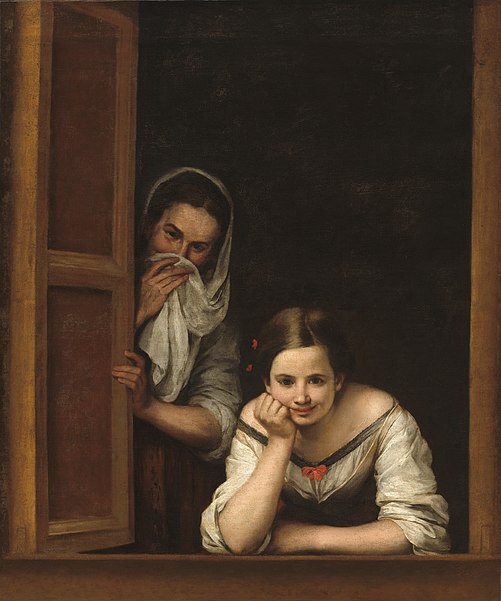
I will probably go more into depth on this item in a future Cabinet of Curiosities carnival, but this 8" x 12" painting was executed by me during my art studies in college.  A copy of "Girl and Her Duena" by Murillo, you can barely see the numbers underneath the paint (lol) but I did make it from scratch (meaning I primed the Belgian linen, stretched it, ground my own pigments, etc.) and it means quite a bit to me.

5. The Family Jewels

No, not those - I never have to worry as to where they are.  I have two items that mean more from a sentimental value perspective than their financial value.

My diamond stud earrings that I wear in each ear mean quite a bit to me.  After I survived the 1989 Loma Prieta earthquake in San Francisco (squeezing under my desk on the 38th floor of Embarcadero Center), I decided to mark such an event by getting my ears pierced.  And shortly after my 40th birthday I treated myself to a pair of 1/4 carat D color, IF clarity, Asscher cut diamonds.  They are unique and the cut/style is not one you see everyday.  Each time I see them I think back to how I survived that day in October, 1989.

The rings I had made from several items of family jewelry including old wedding bands and diamonds.  I designed these and worked with a jeweler back in San Francisco.  Each time I wear them, I am taking many generations in my hand and they travel with me on every journey.

Sunday, September 7, 2008

The Sounds of Family History - Cylinder Recordings


After finding a great website today - Cylinder Preservation and Digitization Project - run by the University of California, Santa Barbara, I had to create a new bookmark folder under my Research folder entitled Music and Sounds.

When documenting your family history, especially if preparing multi-media presentations such as videos, slides shows, etc., you might consider looking into music which was recorded on to cylinders from the turn of the century until the late 1920s. This would be the music from my great-grandparent's time period and I know the collection on this website is not only fantastic but can also be utilized under a modified copyright using a Creative Commons license.

I've never seen a cylinder - the early tin-foil versions, the more common wax or the celluloid version - up close and in person but I've heard family members talk about them. To be honest, they weren't very popular compared to records - let's just say that the wax cylinder of the early 1900s might be like the old reel-to-reel tapes some people had in the 1960s: great for audiophiles but not for com=nsumption by the general public.

But with the Cylinder Preservation and Digitization Project, you have access to hundreds of cylinders that can be used as background music or soundtracks when putting together family history presentations. Take a look around and see what kind of music your ancestors used to listen to!

Photo: Columbia Phonograph Co. Cylinder. Digital image. University of California, Santa Barbara Library.

Monday, September 1, 2008

A Love Untarnished


This post was written for the 55th Edition of the Carnival of Genealogy hosted by Jasia at Creative Gene.

Most of the heirlooms that I do have of the Austin family ancestors are in the form of photos or naturalization certificates, and perhaps some letters. Not many other items exist, perhaps due to the fire that completely destroyed the home of my great-grandparents, John Ralph Austin and Therese McGinnis Austin back in 1979.

But one of my cherished heirlooms which was actually rescued from the debris of that fire, is the wedding silver given to Catherine Sullivan, my 3rd great-grandmother, around 1855 when she wed David O'Keefe.

Catherine Sullivan was born in 1837 in Albany, New York to Daniel P. Sullivan and Mary Griffin, both of whom were from Ireland. Although I have not yet found an exact wedding date, looking at the birthdate of her first child (abt 1855), I can approximate the date to around 1855. Catherine married David O'Keefe who was born in Ireland about 1830.


Catherine and David had seven children, five of whom survived to adulthood, and all were born in Lowville, New York. David O'Keefe died about 1870, not long after the birth of their last child, Maurice D. O'Keefe. Catherine died on February 12, 1928 in the Bronx, New York at the home of her daughter, Catherine O'Keefe Austin.

My mother, Jacqueline Austin MacEntee actually gave me the silver set several years ago before her dementia and subsequential Alzheimer's Disease worsened - we both figured it was time to review items so she could tell me about them. I was absolutely floored when she opened up a small felt bag filled with 12  forks, 12  knives and 3 large serving spoons.

While this may not seem much of a silver set to some, in that it is missing some of the more common items we take for granted today such as salad forks and teaspoons, it is special to me. The spoons are engraved in script with the name "O'Keefe" and although it isn't easy to see in the photos, the engraving is done by hand and not by a machine.

The set appears to be sterling except that the main part of the knives is silverplate, which was common at that time.

I never use the set since it really doesn't have enough pieces for a modern dinner, but from time to time I do open up the bag, polish the silver and reflect on my 3rd great-grandparents. I wonder how life was for them in Lowville, how they weathered major events such as the Civil War. I also wonder how often they used the silver and think that it was probably only used on special occasions such as weddings, baptisms, and holidays.

I also like to think that as often as I have to polish away the tarnish that comes with age, that theirs was a love untarnished.

Photos

Wedding Silver of Catherine Sullivan O'Keefe. Chicago, Illinois, September 1, 2008. Digital image. Privately held by Thomas MacEntee, [ADDRESS FOR PRIVATE USE,] Chicago, Illinois. 2008.

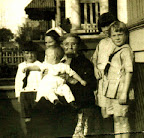
Catherine Sullivan O'Keefe and grand-children. 248 Elm Place, Bronx, New York, abt 1920. Digital image. Privately held by Thomas MacEntee, [ADDRESS FOR PRIVATE USE,] Chicago, Illinois. 2008.

Monday, August 25, 2008

Family Tribute Albums


Just a heads up: RedEnvelope is having a clearance sale on its Family Tribute Albums. The regular price is $64 and they are now $19.99.

I may buy a few and do some early holiday shopping since they seem to be well-made, with acid-free paper, etc. Here are some details:

"Part scrapbook, part family archive, this elegant keepsake album records every reason to cherish parents and grandparents. Both albums are covered in cloth and contain 25 white acid-free recycled pages. Chocolate-colored parent album includes 44 tributette cards with such prompts as, 'The best advice you gave me was…' and 'I will always remember the time…'; camel-colored grandparent album includes 88. Both versions include 48 photo corners. Albums feature a photo window on the cover.

- post bindings allow pages to be added or removed, as needed
- album offered in chocolate parent or camel grandparent; see above for available styles
- may be personalized with a nickel-plated plaque engraved with up to two lines of 20 characters each
- made in USA
- 11" x 9 1/4"H"

Tuesday, August 12, 2008

Mom-isms

Wendy over at All My Branches Genealogy has a great post called What A Bunch of Hooey! as her submission for the 54th Edition of the Carnival of Genealogy. I had forgotten to mention in my earlier post some of my mother's Mom-isms and some of the "'er thans" as we call them.

Mom-isms

Perhaps it is just the New York influence, but people watching was always a leisure time activity in my family, especially if we went into Manhattan for a Broadway show or shopping. When the activities and walking had taken their toll, we'd often sit on a bench and just watch the parade go by.

This is when Mom's sayings usually came out. Her favorites always began with "Would it kill . . ." as in:

"Would it kill her to wear a bra?" This was a frequent one as Mom seemed to be obsessed with the figures of other women. Mom's real passion was that someone should just look "put together" not that they had to be perfect. And usually the end phrase of her lecture was "she'll end up being a 44 Long."

"Would it kill her to run a brush through her hair?" Again, the same theme. One just didn't roll out of bed and leave the house without some proper grooming and "putting on one's face" as she liked to say.

'Er Thans

These are the "comparative" sayings that I heard growing up, some of which I still use. Many family members and friends contributed these. I don't think they need explanation:

"Uglier than a box of broken bells."
"Dumber than a box of hair"
"Hotter than two June brides"
"Hotter than Dutch Love" (which I never understood but knew not to ask)
"Busier than a one-legged man in a butt-kicking contest"
"Busier than a one-armed wallpaper hanger"
"Colder than a well-digger's *ss"

Random Sayings

I grew up with or overheard these as well:

"He was so ugly it looked like his face caught on fire an' someone tried to put it out with a chain!"

"My mother didn't raise any stupid children. Just two ugly ones and they're still at home."

"What do I look like?" (This usually involved something that cost money and children knew, even at young age, that this was a rhetorical question not to be answered)

Wednesday, August 6, 2008

Angie's List®, I'm Ready For My Closeup

I received a call this morning while I was on my way out the door and it was from Angie's List®. They want to come over tomorrow and do a photo shoot for an upcoming issue with a feature article on genealogy.

About a month ago, a received an email from a senior staff writer at Angie's List asking me some questions about genealogy since he had seen my blog. After a few back and forths, I agreed to a telephone interview which would become part of a podcast for Angie's List®. As the interview progressed, I got the impression that the writer also had a personal interest in genealogy. Don't you just know when you talk to someone and they ask certain questions about genealogy that they really want to work on their own family history?

So tomorrow, a freelance photographer will stop by and probably take a few pictures of me in my home office standing in front of my two wall charts and some photos of ancestors. I better start thinking about what to wear! I wonder if I'll be the Angies List® coverboy?

Saturday, July 26, 2008

This Here Journey

With this being my 299th post here (I've already written #300 which will appear tomorrow and deals with how our lives and the lives of our ancestors are affected by technology), I think it is high time I "check in" and summarize what this blog is about.

The Road

Destination: Austin Family began as a travel diary of various journeys taken, and perhaps roads not taken, in searching for my family roots. While this blog first started as an outlet, a way of dealing with the frustration and sorrow of my mother's early onset Alzheimer's Disease at age 58, it has grown to be much, much more. I thought that part of tracing my family history would be to not only gather details from living relatives before those morsels were lost to impaired memory, but also to keep my mind active and busy and somehow stave off an ailment which I know can be genetic among 15% of families with an Alzheimer's sufferer.

The family surnames I research or seek out on this journey are many, but most prominent are MacEntee, McEntee, Austin, McGinnis or McGinnes, Putman, Henneberg, and McCrickert.

The Map

I was luckier than most budding genealogists in that back in 1995 my mother handed me a copy of David Putman and His Descendants privately printed in 1916 by a 2nd cousin 5 times removed. This small booklet traced some of my maternal lines all the way back to 1661 in Schenectady and Albany, New York.

From there, I made investments in genealogy software, purchased subscribtions to sites like Ancestry, Footnote and the New England Historic Genealogical Society, and made many field trips to cemeteries in Rhode Island and New York.

As of today I can trace my heritage back more than 11 generations in several countries, mostly the United States, the Netherlands, England and France.

The Detours

I will admit to some whimsy here and very often I will digress. But isn't that what you do when you try to depict a life as three dimensional? If my intent is to illustrate the lives of my ancestors as more than mere birth dates and death dates, then too I have to be prepared to show not only what interests me, but why.

When I am off on a detour, however, I often will tie it back to genealogy and family history if only to show that I really am not just rambling on and on. One example are my posts about technology and and how our ancestors adapted to new forms of it.

The Compass (or GPS?)

While I don't think my home office is as tricked out as some of my genealogy colleagues, I am running two computers, a scanner, a printer, music (I love my iPod Nano), and I use various tools such as iGoogle, Google Docs, Google Calendar, Jott and facebook®.

Some technologies that are on my list to pursue, thanks to many people like Miriam Robbins Midkiff, Denise Olson, Kathryn M. Doyle and more, include Adobe Photoshop Elements and digital scrapbooking, Twitter, Diigo, Stumble Upon, and more.

The Emotions

Very often travel is the act of taking in and absorbing all that the sense see, feel, hear, smell and more during that trip. And it is easy to find yourself elated as well as angered over some of what you witness. As an outlet, there is my writing.

And I have to thank my good friend Jasia for all her support and feedback in this realm - she was one of the first genea-bloggers with whom I made contact and felt a true kinship. It is more than just our shared experiences of a parent with Alzheimer's Disease but a true love of writing and trying to place our family history into words not data that unites us.

I write almost every day but I don't publish every piece here on this blog. What do I write about? Everything from how I spent my summers in Grahamsville, New York to the house I grew up in and to family members who made the ultimate sacrifice.

The Traveler

Finally, a bit about me which could help put all of this in perspective. I grew up in the Catskill Mountain region of upstate New York during the 1960s and 70s. I went to college in Washington, DC and then moved out to California where I lived in San Francisco for the next 18 years. While my academic background was history, art and Spanish language and literature, I somehow fell into the burgeoning technology industry of the early 1980s with the debit of the IBM Personal Computer.

While temping at various firms, I found my niche as an Information Technology specialist working for global law firms - firms often with as many as 1,500 attorneys across the globe. My positions have included software trainer, technical writer, document production supervisor, and now applications analyst. Currently I work for Heller Ehrman LLP which is based in San Francisco but I do so from my home in Chicago. I develop in-house applications using Microsoft Office as well as manage information technology projects from inception to deployment and support.

When I am not working, which seems to be 24/7, I enjoy researching new technologies to use with my family research. And very often, as you may have heard, I will pull my blogging colleagues (we call ourselves Genea-Bloggers) to those new technologies, sometimes kicking and screaming.

I have lived in Chicago for the past four years with my partner of over eight years. We live in a rehabbed 1903 brick three-flat in the Andersonville section, right on Lake Michigan. Having Chicago as a base allows me to fly home often to check in on Mom as well as to catch flights to any point in the world. My favorite destination, and where I intend to retire to in about 15 years: Reno/Lake Tahoe.

The Destination

Where will I end up on this journey. I don't worry about that so much more as much as making sure that I experience each step and try to best convey it to you, the reader.

Wednesday, July 23, 2008

I was MOOved


A few weeks ago, footnoteMaven at Shades Of The Departed discussed business cards and using a new service called MOO to create affordable versions in a "mini" format.

Lately, I've been looking to have some "calling cards" created - I didn't want business cards since my firm already provides those to me free of charge albeit with tons of work-related data. I wanted a card that I could give to family when talking about genealogy or when meeting new people and discussing family history or other topics.

So, taking fM's advice, I wandered over to MOO and create the Mini-Moos shown above. I also ordered the small case which is great and holds just enough cards when heading out to a gathering. Note: the image above shows the front and back of one card.

Although I claim to be almost "paper free," I find there are times when technology just doesn't serve me and I need something more tactile when meeting people face to face.

Monday, July 21, 2008

This Old House

This post is more family history oriented and while it deals with a recent bathroom remodel in my Chicago home, it got me to thinking of what kind of home improvements my ancestors may have made. As you read below and view the before and after photos, ponder the following and how they apply to those in your family tree:

- growing up, did your family embark upon a major home improvement such as a kitchen, bathroom or building an addition for more space?

- did anyone in your family history experience major damage to their home that required repair? What were the circumstances of the damage?

- have you come across any family history related to when indoor plumbing was installed? An electric or gas stove instead of a wood stove? An ice box and then a refrigerator?

I'll post some of my responses later this week - I've already done some research on the Freer-Low House in New Paltz, New York which was built by one of my ancestors, Hugo Freer, and in a separate post I'll discuss the many additions made since the late 1600s.

Now, on to the remodel. Although my home is only two years old it really is 105 years old. How can that be? Well, I live in what is called a "condo rehab" which is quite popular in Chicago. A developer or builder purchases a two-flat or three-flat building (a flat means an apartment that runs the entire length of that floor which is different than a duplex or triplex which take up two or three floors). They usually gut the inside and replace everything with more modern amenities including different floorplans. Sometimes they will add a balcony or deck and a car port or garage. This arrangement allows you to own your own home many times with unique architectural touches such as exposed brick, oak staircases and floors, etc.

That being said, I never like the master bathroom and it had become a sticking point in negotiating a purchase price. The developer obviously had purchased the cheapest and smallest shower stall available at Home Depot or Lowes. Seriously small - as in cruise ship shower. I could not even raise my arms in that shower and felt like veal.

So about a month ago, the project started after we chose our tiles, fixtures, colors, etc. A relative was doing the contracting work and I couldn't be happier with the way in which it turned out. The goals were to:

- enlarge the shower even if it meant building a custom tray and ordering a custom shower enclosure and door

- add more storage space with a built-in linen cabinet behind the door

- add more surface space with a larger vanity and installation of a vessel bowl sink

Here are the results!

BEFORE


AFTER